
· Last checked: 16 October 2026
This guide is general information, not legal advice. Immigration rules and figures change, and each consulate sets its own requirements, so confirm with yours or an immigration lawyer before you apply.
The short answer: Which route you take depends on your passport and on how you’ll support yourself. EU, EEA and Swiss citizens need no visa; they register in Valencia if they stay longer than three months. Everyone else needs a visa or permit before moving. The most common are:
- the non-lucrative visa, for living on savings or a pension without working (€2,400 a month in 2026)
- the digital nomad visa, for remote work for foreign employers or clients (€2,849 a month)
- a work permit, sponsored by a Spanish employer
- a student visa
The Golden Visa closed to new applications in April 2025.
Key facts
- Without a visa, you can stay up to 90 days in any 180-day period across the whole Schengen area, as a visitor only.
- The non-lucrative visa requires 400% of the IPREM: €2,400 a month (€28,800 a year) for the main applicant, plus €600 a month for each family member. The IPREM is still €600 a month in 2026. (Arc Legal)
- The digital nomad visa requires 200% of the minimum wage (SMI). The SMI is €1,221 a month in 14 payments for 2026 (Real Decreto 126/2026), which puts the threshold at about €2,849 a month, plus €1,068 for the first family member and €356 for each additional one. (Garrigues, Migratiolex)
- No new Golden Visa applications have been accepted since 3 April 2025 (Ley Orgánica 1/2025). (Spain’s ONE office)
- A renewed non-lucrative permit lasts two years. To renew, you must have lived in Spain for more than 183 days in the year. (Ministerio de Inclusión)
- Spain’s new immigration regulation (Real Decreto 1155/2024) has applied since 20 May 2025. Among the changes, students in higher education can now work up to 30 hours a week. (EY)
Every move to Valencia starts with the same question: which permission do I need to be here? Get it wrong and you can lose months to a refused application, or end up on a visa that doesn’t let you do the work you came for. This guide sets out every route side by side, so you can find yours before you speak to a consulate or a lawyer.
Every route, at a glance
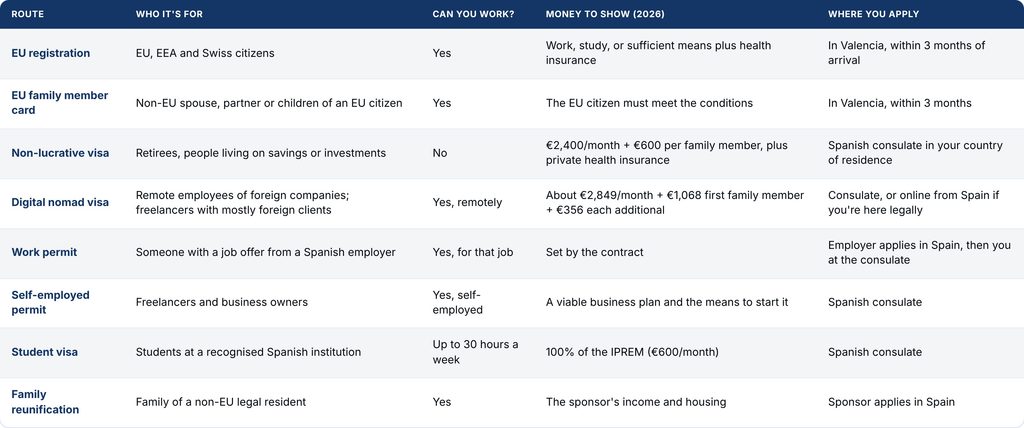
EU, EEA and Swiss citizens
You don’t need a visa. If you stay longer than three months, you must register in person and get the certificado de registro, often called the “NIE verde”. You’ll need to show that you’re working, studying, or have enough money plus health insurance. There’s no fixed figure for “enough”. In practice, offices benchmark against the non-contributory pension threshold, so plan comfortably above €8,803 a year per person. Our NIE vs TIE guide covers how to book the appointment.
The non-lucrative visa
This is the classic route for retirees and anyone living on a pension, savings or investments. You apply at the Spanish consulate in the country where you live, with proof of income, private health insurance with no co-payments, a criminal record certificate and a medical certificate. Once it’s approved, you have to enter Spain while the visa is valid and apply for your TIE within a month of arriving. The first permit lasts a year, and renewals last two.
The catch is in the name: you can’t work in Spain, and consulates generally treat remote work as work too. If you plan to keep your job remotely, look at the digital nomad visa instead.
The digital nomad visa
This is for non-EU citizens who work remotely for a company based outside Spain, or who freelance mostly for foreign clients. Spanish clients can make up no more than 20% of a freelancer’s income. Employees need at least three months with their employer. Most applicants also need a university degree or three years’ experience in their field.
You can apply at a consulate before you travel, or online through Spain’s fast-track unit for large companies and strategic groups (UGE) if you’re already here legally, for example as a visitor. Applying from inside Spain gets you a three-year residence permit straight away. The UGE has 20 working days to answer. If it doesn’t, the application counts as approved.
Working for a Spanish employer
This process runs backwards from what most people expect. Your employer applies for your work authorisation in Spain first. Unless your job is on the shortage-occupation list or another exemption applies, the employer must also show the post couldn’t be filled locally. Once that’s approved, you apply for the visa at your consulate. Highly qualified hires, intra-company transfers and entrepreneurs with an innovative project go through the faster UGE route instead.
Working for yourself
Non-EU citizens who want to freelance or run a business from Spain need the self-employed permit (cuenta propia). You’ll need a business plan, proof that you have the qualifications and money to carry it out, and any licences the activity requires. Once you’re here, registering as autónomo is a separate step. Our autónomo guide walks through it.
Bringing your family
If you’re an EU citizen, your non-EU spouse, partner and children apply for the EU family member card in Valencia. If you’re a non-EU resident, you can usually sponsor your spouse or partner, your children and, in some cases, dependent parents through family reunification (reagrupación familiar), generally after a year of legal residence. Family members who come through reunification can work.
After five years, and beyond
After five years of continuous legal residence, you can apply for long-term residence, which removes most restrictions on where and how you work. Spanish citizenship normally takes ten years of residence. It takes two years for nationals of Ibero-American countries, Andorra, the Philippines, Equatorial Guinea and Portugal, and one year if you’re married to a Spaniard. Keep every stamped document from day one; you’ll need the paper trail.
Visa decisions don’t happen in Valencia: they’re made by consulates, by the UGE, or by the Oficina de Extranjería, which has offices at Calle Diputada Clara Campoamor 23 and Calle Joaquin Ballester 39. Requirements also vary by consulate. If your case is unusual, an immigration lawyer is worth the fee.
FAQ
Only if you’re an EU, EEA or Swiss citizen. Everyone else can visit for up to 90 days in any 180, but needs a visa or permit to live here.
€2,400 a month (€28,800 a year) for the main applicant, plus €600 a month for each family member, and private health insurance.
About €2,849 a month, plus €1,068 for the first family member and €356 for each additional one.
No. That includes remote work for a foreign employer, which consulates generally treat as work. The digital nomad visa is the route for remote workers.
Yes, if you’re in Spain legally. Apply online through the UGE, and you’ll receive a three-year residence permit if approved.
No. No new applications have been accepted since 3 April 2025.
Usually ten years of legal residence; two years for nationals of Ibero-American countries, Andorra, the Philippines, Equatorial Guinea and Portugal; one year if married to a Spaniard.
Related guides
- New in Valencia: Guides for Settling In
- NIE vs TIE: What They Are and How to Get a Cita in Valencia
- Going Autónomo in Valencia: How to Register as Self-Employed
- Opening a Bank Account in Valencia: A Newcomer’s Guide
- Moving to Valencia: Your First 90 Days, in Order
Most visa trouble comes from choosing the wrong route, not from the paperwork itself. Work out how you’ll support yourself first, match that to the table above, then check the current requirements with your consulate before you gather a single document.