
Last checked: 15 October 2026
This guide is general information, not tax or legal advice. Contributions and tax rules change every year, so check your case with a gestor or the Agencia Tributaria.
The short answer: To work as a freelancer in Spain, you register twice: with the tax office (Agencia Tributaria) on Modelo 036, and with Social Security in the self-employed scheme (RETA), no later than the day you start. Your first 12 months cost a flat €80 a month, about €88.70 with the pension surcharge. After that, contributions depend on your net income: roughly €205 to €607 a month in 2026. You’ll file VAT and income tax returns every quarter. EU citizens can register freely; non-EU citizens need a permit that allows self-employment, which the non-lucrative visa does not.
Key facts
- 2026 contributions are frozen at 2025 levels. The only change is the intergenerational equity surcharge (MEI), which rose to 0.9% of your contribution base. (Infoautónomos)
- The flat rate (tarifa plana) is €80 a month for 12 months, about €88.70 with the MEI. If your net income stays below the minimum wage, you can extend it for 12 more months. You qualify if you haven’t been registered as autónomo in the previous two years, or three if you’ve had the flat rate before. (Billin)
- Modelo 036 is now the only registration form. The simplified Modelo 037 was withdrawn on 3 February 2025 (Orden HAC/1526/2024). (Agencia Tributaria)
- New professionals can apply 7% income tax withholding on invoices to businesses instead of 15%, in their first year and the two years after. (Infoautónomos)
- Verifactu, the new invoicing-software requirement, isn’t mandatory yet. By law it applies to autónomos from 1 July 2027 (Real Decreto-ley 15/2025). In October 2026 Hacienda announced it will push that back to October 2028, but the delay hasn’t been approved yet. (Infoautónomos)
Valencia has a large community of freelance designers, translators, developers, teachers and consultants, and sooner or later most of them become autónomos. Registering is less painful than its reputation suggests. What catches people out is everything around it: doing the two registrations in the right order, picking the right activity code, and knowing what you’ll owe each quarter.
Can you register as autónomo?
- EU, EEA and Swiss citizens: yes, on the same terms as Spaniards, once you have your EU registration certificate and NIE.
- Non-EU citizens: only with a residence permit that allows self-employment, such as the self-employed permit (cuenta propia), long-term residence or a family member card. Digital nomad visa holders who freelance also register as autónomo. The non-lucrative visa does not allow it.
Before you start
- Your NIE, and your TIE or EU registration certificate
- Cl@ve or a digital certificate, so you can file online
- A Spanish bank account for your monthly contribution
- A clear description of your activity, to pick the right IAE code (epígrafe)
- A start date. Both registrations hinge on it, and working before you register can mean fines.
Registering, step by step
- Register with the Agencia Tributaria (Modelo 036). File it online with your Cl@ve or digital certificate. On it you declare your activity code, your VAT regime and how your income tax is calculated (most freelancers use estimación directa simplificada). If you’re a new professional, this is also where you can claim the reduced 7% withholding.
- Register with Social Security (RETA). Do it online through Import@ss no later than the day you start, ideally on the same day as the 036. Tick the flat rate (tarifa plana) if you qualify, and choose the income band you expect to earn.
- Set up your invoicing. Each invoice needs a sequential number, your NIE, your client’s details, VAT, and any income tax withholding. A simple invoicing app saves you a lot of trouble at quarter end.
Your Social Security number (NAF)
Your Social Security number (NAF, also called NUSS) is different from your NIE. If you’ve worked for an employer in Spain, you already have one: your employer requested it. If you haven’t, request it before registering in RETA, through Import@ss with Cl@ve or a digital certificate, or in person at a Social Security (TGSS) office with form TA.1 and your NIE and passport. You keep it for life.
What it costs in 2026
After the flat rate ends, your monthly contribution depends on your expected net income. You pick a band, and Social Security checks it against your tax return the following year. If you earned more, you pay the difference; if you earned less, you get a refund.
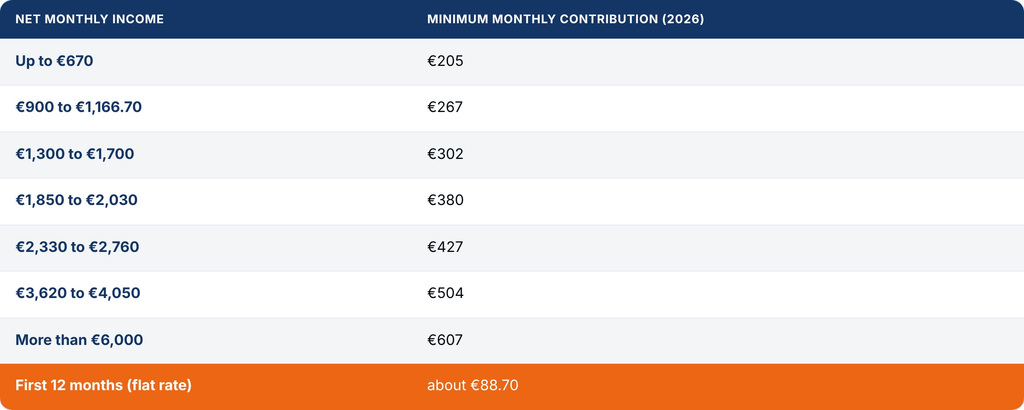
This is a selection of the 15 income bands; the full table is on the Social Security website. Net income means what you earn minus deductible expenses, plus a 7% allowance for general costs.
Your quarterly paperwork
- Modelo 303: your quarterly VAT return. In practice, you pass on the VAT you’ve charged, minus the VAT you’ve paid on business expenses.
- Modelo 130: a quarterly advance on your income tax. You don’t need to file it if at least 70% of your income already has withholding applied, which is common when your clients are Spanish businesses.
- Modelo 100: your annual income tax return (renta), filed between April and June. It reconciles the year.
Quarterly returns are due in the first 20 days of April, July and October, and by 30 January for the last quarter.
Do you need a gestor?
You don’t have to use one, but most autónomos in Spain do, Spanish and foreign alike. A gestor (accountant and admin agent) typically charges €40–70 a month to file your quarterly returns, check your activity code and spot deductions you’d miss. It’s especially worth it in year one, or if you have income from abroad.
FAQ
About €88.70 a month for the first 12 months on the flat rate. After that, between roughly €205 and €607 a month, depending on your net income.
Yes. EU citizens register freely. Non-EU citizens need a permit that allows self-employment, which the non-lucrative visa does not.
The tax office form that registers your business activity, activity code and VAT regime. It’s now the only registration form; Modelo 037 was withdrawn.
A flat €80 a month in Social Security contributions (about €88.70 with the MEI) for your first year as a new autónomo. It’s extendable for a second year if your net income stays below the minimum wage.
Yes. If you’ve never worked in Spain, request your NAF through Import@ss or at a Social Security office before registering in RETA.
A reduced income tax withholding that new professionals can apply on invoices to businesses during their first three years, instead of the standard 15%. You’ll settle any difference on your annual return.
Related guides
- New in Valencia: Guides for Settling In
- Visas for Valencia: Every Route to Living in Spain, Explained
- Opening a Bank Account in Valencia: A Newcomer’s Guide
- Cl@ve and the Digital Certificate: How to Get Spain’s Online ID
- NIE vs TIE: What They Are and How to Get a Cita in Valencia
Register on the day you start, claim the flat rate, and put a quarter of every invoice aside for VAT and tax. Do those three things and being autónomo in Valencia is much more manageable than the horror stories suggest.