Last checked: 9 October 2026
This guide is general information, not financial or legal advice. Bank fees, products and requirements change and vary from bank to bank, so check the current terms with the bank before you open an account.
The short answer: You don’t have to wait for your residency to open a Spanish bank account. Before your TIE or EU certificate arrives, you can open a non-resident account with your passport and a certificado de no residente, then convert it once you’re resident. Bring your passport, your NIE if you have it, proof of address and proof of income. N26 and Revolut both give Spanish IBANs now and work well for the first weeks. And anyone legally resident in the EU has a legal right to a basic account costing no more than €3 a month.
Key Facts
- Spanish banks treat residents and non-residents differently. A non-resident account usually needs a certificado de no residente, issued by the Policía Nacional and valid for three months. (Policía Nacional)
- The certificate fee is paid with Modelo 790, Código 012 under “certificados o informes”: €7.31 in 2026. (Orden PJC/617/2025)
- Every legal resident of the EU can open a cuenta de pago básica (basic payment account). It costs at most €3 a month, is free for people in a vulnerable situation, and covers 120 euro payments a year. (Banco de España)
- A landlord, employer or utility can’t refuse your account because its IBAN is from another EU country. That’s “IBAN discrimination”, and it breaks the EU SEPA Regulation. (Banco de España)
- N26 has given new Spanish customers ES IBANs since 2019, and Revolut now operates as a registered bank branch in Spain with ES IBANs for new customers. Wise accounts still use a Belgian IBAN. (N26)
- US citizens are asked to fill in a W-9 form at account opening, because Spanish banks report US account holders under FATCA.
Rent, the electricity bill, your salary, your autónomo contributions: in Spain almost everything runs on direct debit from a local account. The good news is that you can open one earlier than most people think. The trick is knowing which kind of account you qualify for right now, and which papers the bank will ask for.
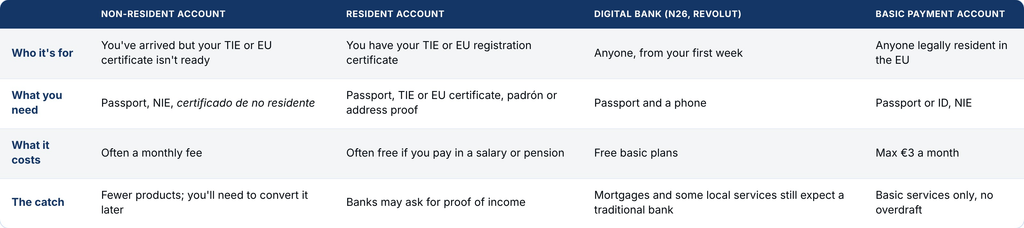
Your options, side by side
What to bring
- Your passport
- Your NIE, TIE or EU registration certificate, if you have them
- Proof of address: a padrón certificate, rental contract or recent utility bill
- Proof of income: payslips, an employment contract, a pension statement or recent bank statements
- Your certificado de no residente, if you’re opening a non-resident account
Banks are required to check where your money comes from, so expect questions about your job and income. It’s routine, not suspicion.
How to get the certificado de no residente
- Fill in the EX-15 form. It’s the same form used for NIE requests, available from the Ministerio de Inclusión.
- Pay the fee. Generate Modelo 790, Código 012, choose “certificados o informes” and pay it at any bank. You don’t need an account there.
- Book a cita. On the national extranjería portal, choose Valencia and the police procedure for certificates (residence, non-residence and concordancia).
- Attend with your passport and a copy of it. The police have up to five days to issue the certificate, and it’s valid for three months, so time it close to your bank appointment.
Some banks request the certificate for you, or open the account and give you a few weeks to bring it. Ask before you book a cita you might not need.
Fees, and how to avoid them
Spanish banks commonly charge a monthly maintenance fee unless you pay in a salary or pension, or meet other conditions. Before you sign, ask for the fee sheet (información precontractual) and check what happens if you stop meeting the conditions. When you become resident, take your TIE or EU certificate to the bank so they switch you to a resident account. Banks periodically ask non-resident customers to prove their status, and a lapsed certificate can get your account restricted.
Digital banks as a bridge
Most newcomers open N26 or Revolut in their first week, because all you need is a passport and a phone. With an ES IBAN, these accounts work for rent, bills and salary. Wise is excellent for moving money between currencies, but its IBAN is Belgian. Some Spanish companies still push back on foreign IBANs, even though refusing them is illegal. If that happens, ask them in writing to accept it. If they refuse, complain to the Generalitat’s consumer office (for businesses) or to the Banco de España.
If a bank says no
Banks can turn down a standard account for many reasons, often because their anti-money-laundering checks aren’t satisfied. The basic payment account is different: the law gives you the right to one. If a bank refuses it, it has to tell you why, in writing and free of charge. Complain first to the bank’s customer service, then to the Banco de España.
FAQ
Some banks open a non-resident account with just a passport, but most will ask for a NIE soon after. N26 and Revolut usually only need a passport.
An official certificate from the Policía Nacional confirming you aren’t resident in Spain. Banks use it to open non-resident accounts. It’s valid for three months.
Yes. Within the EU, a landlord, utility or employer can’t refuse an account because its IBAN is from another EU country.
Many are free if you pay in a salary or pension. Otherwise, expect a monthly fee. A basic payment account costs no more than €3 a month.
Your passport, your NIE or residence card, proof of address and proof of income. Non-residents also need the certificado de no residente.
Yes. Bring your TIE or EU registration certificate so the bank converts your account and stops asking for non-resident paperwork.
Related guides
- New in Valencia: Guides for Settling In
- NIE vs TIE: What They Are and How to Get a Cita in Valencia
- Empadronamiento in Valencia, Step by Step
- Going Autónomo in Valencia: How to Register as Self-Employed
- Moving to Valencia: Your First 90 Days, in Order