Last checked: 16 October 2026
Admission dates, points and fees change every year. Check the Conselleria’s official calendar and each school’s own information before you apply.
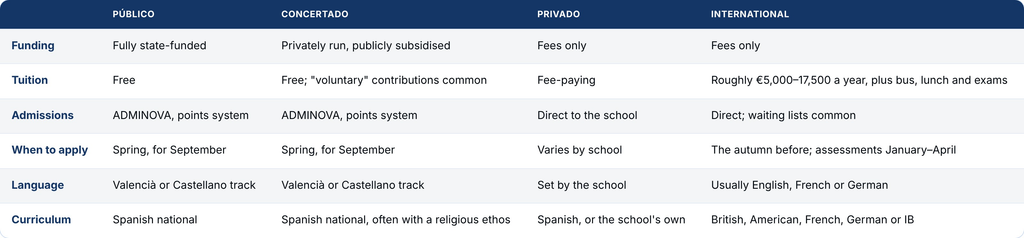
The short answer: Valencia has four kinds of school:
- público: free and state-run
- concertado: privately run but publicly funded, so tuition is free
- privado: fee-paying, Spanish curriculum
- international: fee-paying, foreign curriculum (British, IB, French, German or American)
Public and concertado places are handed out through the online ADMINOVA portal each spring, using points for siblings, where you live or work, and family income. In 2026 the Infantil and Primaria window ran from 7 to 18 May. Families choose Valencià or Castellano as the main teaching language. Children new to the Valencian system can be exempted from Valencià grades for their first two years.
Key facts
- You can apply to any school in the city. Valencia works as a single district (distrito único) under Decreto 48/2024. Living anywhere in the city earns the same 10 points for proximity. (Educalista, citing the 2026–27 resolution)
- Points decide oversubscribed schools: 15 for a sibling already at the school, 10 for home or work in the area, up to 7 for lower family income, and 5 or 7 for large or single-parent families. (Educalista)
- The 2026–27 applications ran 7–18 May for Infantil and Primaria, and 21 May–1 June for ESO and Bachillerato. The 2027–28 calendar is usually published in late February or March. (Educalista)
- Newcomers can be exempted from Valencià assessment. Children entering the Valencian system for the first time can skip Valencià grades in their year of arrival and the following year. Families who can prove their residence is temporary can get up to three consecutive years. (Ley 1/2024, art. 14)
- Concertado tuition is free by law (LOE, art. 88). In 2025, though, the regional ombudsman called “voluntary” fees a widespread practice and asked for more inspection. (Valencia Plaza)
- Nursery (0–3) is free in the Comunitat Valenciana since 2024–25, with monthly aid of up to €460 at authorised private centres. (Valencia Plaza)
Choosing a school is hard enough at home. Abroad, you’re also decoding a new system, a new vocabulary and, in Valencia, a second regional language. This guide maps every option, from the free local school to the international schools, so you can see which ones fit your child before you start visiting.
The four types of school, side by side
Public schools
Public schools follow Spain’s national curriculum (set under the LOMLOE education law), with part of it adapted by each region. Children start Infantil at 3, Primaria at 6 and ESO (secondary) at 12. School is compulsory until 16. After ESO, students take either the two-year Bachillerato, the academic route to university, or Formación Profesional (FP), vocational training that’s well regarded in Spain. Unlike the British system, students keep a broad range of subjects to the end. English is taught from the early years.
Tuition is free. Textbooks are lent free through the regional book bank (Banco de Libros, still widely called Xarxa Llibres). You pay for school lunch (comedor), after-school activities and materials beyond textbooks.
How admissions work
Public and concertado schools share one admissions system. You apply online through ADMINOVA, listing schools in order of preference. If a school has more applicants than places, points decide:
- Siblings at the school: 15 points
- Home or parent’s workplace in the area: 10 points. Valencia city counts as one area, so most registered residents get the full 10.
- Family income: 4–7 points, more for lower incomes
- Large or single-parent family: 5 points (general) or 7 (special)
- Disability of the child or a family member: 3–7 points
To apply, you need your NIE and its support number, or Cl@ve or a digital certificate. You also need to be on the padrón, because your address is checked automatically. If you arrive mid-year, ask the Conselleria’s local education office (Dirección Territorial) about a place outside the normal window.
Valencià or Castellano?
Since the 2024 Educational Freedom Law, families choose the base teaching language, Valencià or Castellano, and schools organise classes around those choices. The other language is still taught as a subject.
For children arriving from abroad, the key rule is the exemption. In their first year in the Valencian system and the following one, they can be exempted from assessment in Valencià. They still attend the class, but they aren’t graded on it. If your stay is temporary and you can prove it, the exemption can last up to three consecutive school years. Request it from the school with form F114013. (Ley 1/2024)
Concertado schools
Concertado schools are privately owned but publicly funded. In exchange, they follow the Spanish curriculum and take part in the public admissions system. Many have a religious ethos, because Spanish law lets them define their own carácter propio.
By law (LOE, art. 88), they can’t charge for the education they provide free, can’t require donations, and can’t make paid services compulsory. In practice, many ask for a monthly “voluntary” contribution. In June 2025 the regional ombudsman, the Síndic de Greuges, found the practice widespread and asked the Conselleria to inspect it, warning that it shuts out families who can’t pay. If a school presents a fee as compulsory, you’re entitled to refuse it.
Private schools with the Spanish curriculum
These are fully fee-paying but teach the same Spanish curriculum, leading to the same Bachillerato and university entrance exam. Families choose them for bilingual English–Spanish programmes, longer school days, smaller classes or a particular philosophy, such as Montessori. Whether they’re worth the money is another question: see our piece on the latest PISA report.
British-curriculum schools
British schools follow the National Curriculum of England, adapted for Spain, from Early Years to Sixth Form. Students sit GCSEs or IGCSEs at 16 (Year 11), then narrow to three or four A-levels in Years 12 and 13. Exams are set and marked by UK exam boards, and the results count exactly as they would in the UK.
Before you choose, check that the school belongs to NABSS, the National Association of British Schools in Spain, which inspects its members. Ask to see the latest inspection report: good schools are happy to share it.
The International Baccalaureate (IB)
The IB isn’t a national curriculum. It’s run by the International Baccalaureate Organization, a non-profit based in Geneva, and taught and assessed the same way worldwide, which suits families who might move again. In Spain the programme that matters most is the two-year IB Diploma, taken in place of the Bachillerato years. It covers six subjects across languages, sciences, maths, humanities and the arts, plus an extended research essay, a critical-thinking course and a community-service component.
Other international schools
- Lycée Français International de Valencia: a French state school abroad, run by France’s agency for French education abroad (AEFE). It teaches the French curriculum from maternelle to the baccalauréat, so children can move to or from France without losing pace. Within the Spanish system, some public secondary schools also offer the Bachibac, a joint Spanish–French Bachillerato.
- Deutsche Schule Valencia: the official German school abroad, teaching mainly in German, with Spanish, Valencià and English. It runs from kindergarten to the Abitur, which Spain recognises as equivalent to the Bachillerato.
- American School of Valencia: a US-style curriculum taught in English up to Grade 12, leading to an American high-school diploma. Most students also take the IB Diploma in the final two years.
Getting to university: two routes
- The Spanish route. Students finish the Bachillerato and sit the PAU, the university entrance exam. The access grade is 60% Bachillerato average and 40% PAU, and you need 5 or more out of 10.
- The international route. Students with A-levels, the IB Diploma, the French baccalauréat or the Abitur usually apply through UNEDasiss, run by Spain’s national distance-learning university. It converts their results into a Spanish grade out of 10. They can also sit UNED’s subject exams (the PCE) to raise that grade, as Spanish students do with the PAU. Most public universities accept UNEDasiss. Private universities set their own rules, so check each one’s admissions page.
Before school: nurseries for 0–3s
Infantil from 3 is free in public and concertado schools. Before that, the Comunitat Valenciana has made nursery education for 0–3s free since 2024–25. Public nurseries cost nothing, and authorised private nurseries receive monthly aid of up to €460 for babies under 1, €350 for 1-year-olds and €300 for 2-year-olds. Applications open each July.
FAQ
A privately run school funded by the state. Tuition is free by law, and it can only ask for voluntary contributions.
You apply online through ADMINOVA in spring. If a school is oversubscribed, places go by points for siblings, home or work address, family income and family situation.
Any public or concertado school. Valencia works as a single district, so living anywhere in the city earns the same proximity points.
The calendar is usually published in late February or March. In 2026, Infantil and Primaria applications ran from 7 to 18 May.
In public and concertado schools you choose a Valencià or Castellano base, and both languages are taught. Private and international schools set their own policy.
Children new to the Valencian system can be exempted from Valencià assessment in their first year and the next. With proof of temporary residence, the exemption lasts up to three years.
Usually through UNEDasiss, which converts A-levels, the IB, the French bac or the Abitur into a Spanish grade out of 10.
Related guides
- New in Valencia: Guides for Settling In
- Empadronamiento in Valencia, Step by Step
- Cl@ve and the Digital Certificate: How to Get Spain’s Online ID
- Is Private School Even Worth It? PISA Just Made the Question Harder
- Moving to Valencia: Your First 90 Days, in Order
There’s no single right school, only the right fit for your child and how long you plan to stay. If you’re here for good, a local school gives your child the language and the friends. If you might move again, an international curriculum keeps doors open. Either way, register on the padrón early and mark the May application window in your calendar.
Sources
- Educalista — Valencia school admissions 2026–27: dates, points and ADMINOVA
- DOGV — Ley 1/2024, Educational Freedom Law
- Conselleria de Educación — Admissions regulations
- Valencia Plaza — The Síndic on concertado fees (June 2025)
- Valencia Plaza — Free 0–3 education
- NABSS — British schools in Spain
- International Baccalaureate Organization
- UNEDasiss