
Spain is famously rich in sunshine and a relaxed way of life, and famously short on jobs. Spend five minutes in any of the dozens of Facebook groups for people living here and you’ll see post after post that begins: “I’m looking for a job.” On the job portals, a single listing can draw hundreds of applications.
But believe it or not, Spain has never had so many people in work: between July and September, the country reached 22.85 million jobs, an all-time high.
And yet unemployment went up. Over the same three months, the number of people out of work and looking for a job rose by 95,900, to almost 2.6 million. The unemployment rate climbed to 10.18%.
It seems to make no sense, but the line is getting longer. Here is the paradox:
On the one hand, more people are joining the workforce than there are new jobs to absorb them. Spain now has 443,500 more people working or looking for work than it did a year ago.
And, on the other hand, part of that growth comes from newcomers, and many of them are already in work. As of October, one in six workers in Spain is a foreign resident: in total, almost 3.7 million people are registered with Social Security.
If job hunting in Spain feels like standing in a long line, that’s because it is. And it isn’t the only line you’ll stand in.
A long line in Europe, and longer in Valencia
By European standards, the wait is long. Only Finland, at 10.5%, has a higher unemployment rate than Spain’s 10.3% and across the euro area, the average is 6.5%.
For young people, the line stretches further. Nearly one in four under-25s looking for work in Spain can’t find it.
Here in Valencia, the line is longer still. This autumn, the Comunitat Valenciana saw the biggest rise in unemployment of any region in Spain. Between July and September, the number of unemployed people here rose from 304,600 to 335,600, an increase of 31,000 people (about 10%) in just three months. Andalucía still has the highest unemployment rate in Spain, at 14.91%, but no region added more unemployed people this quarter than Valencia.
That leaves the regional rate at around 11.8%, almost two points above the national figure. Newcomers felt it first: of the people who signed on as unemployed in October, almost two in three were foreign nationals.
And when the job does come, it tends to pay less. The average salary here is about €26,800 a year, roughly €227 a month below the Spanish average.
Next to Madrid, the gap grows to around €7,600 a year.
The second line: your degree
But getting into the job market is one thing. Getting in at your level is another.
Spain has the highest overqualification rate in the EU: one in three graduates works in a job that doesn’t need their degree. Across the EU, it’s closer to one in five.
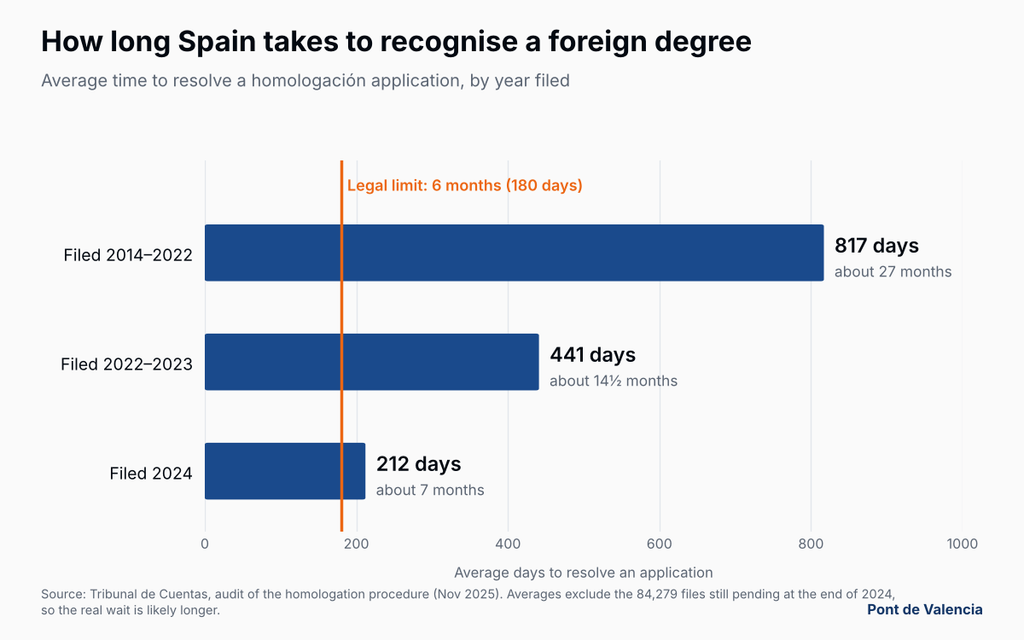
The knock-on effect: even jobs that don’t need a degree attract graduates, and newcomers applying for those roles find themselves up against people with more qualifications than the job asks for. For anyone with a foreign degree, there’s an extra hurdle on top of that. If you work in a regulated profession, such as medicine, nursing or teaching, your degree needs official recognition before you can practise. It’s called homologación, and by law it should take six months.
But as everthing in Spain has been, reality has been slower. Spain’s Court of Auditors found that applications filed between 2014 and 2022 took more than two years on average.
It is getting faster: applications from 2024 averaged around seven months. Still, by the end of that year, more than 84,000 files were waiting for an answer.
The Court has even suggested letting experienced professionals work while they wait. For now, that’s a recommendation, not a rule.
Should you skip the line and go self-employed?
Plenty of people have decided to stop waiting. Spain now has more than 3.5 million registered self-employed workers, more than ever before.
Most of the new ones came from elsewhere. Eight in ten people who registered as autónomos over the past year were born abroad, and Valencia leads the country in new foreign self-employed workers; for example, British nationals are well represented, with more than 26,000 registered.
It comes, of course, with all the headaches of being self-employed. We recently talked with someone who had just moved to Valencia and was looking to start his own business. The bureaucracy and the fierce competition for rental premises made him put the business on hold after many months of trying. But maybe that’s a story for another day.
Going self-employed can get you out of one line, but only if you can make it work.
Put it all together and the problem looks less like a shortage of jobs than a series of lines: one to get hired, another to be hired at your level, and, in some professions, a third one for paperwork.
None of that shows up in the headline unemployment rate. A doctor waiting for homologation who works in a bar counts as employed. So does a freelancer living through a quiet winter.
The statistics tell you whether people are working. What they can’t tell you is whether the work fits the person doing it, or how long that person stood in line to get it. And for anyone rebuilding a career in a new country, those are often the numbers that count most.
Related content
Going Autónomo in Valencia: How to Register as Self-Employed