At the beginning of last week, one of the talks of the town was the release of new pictures of the future Parc Central station. Locals and long-term residents were excited about the look of the place — with its high, wave-like ceiling, it looked straight out of Blade Runner. But that is not the only major development plan in Valencia’s future. In the upcoming years, the city will have a handful of new impressive landmarks that will make the city almost unrecognisable to anyone who knew it a decade ago. Here are some of those projects that will reshape it.
The station Valencia has been waiting for since the 1980s
The idea of burying Valencia’s railway lines and building a proper central station above the recovered land has been on the city’s planning documents since the 1980s. It has been redesigned several times, and then quietly shelved when the financial crisis hit.
That is now changing. In late 2025, Adif formally tendered the design contract for the Nueva Estación Central. The contract — worth €30 million for the design phase alone, with a four-year timeline to produce a construction-ready project — was awarded to the Basque engineering group Sener.
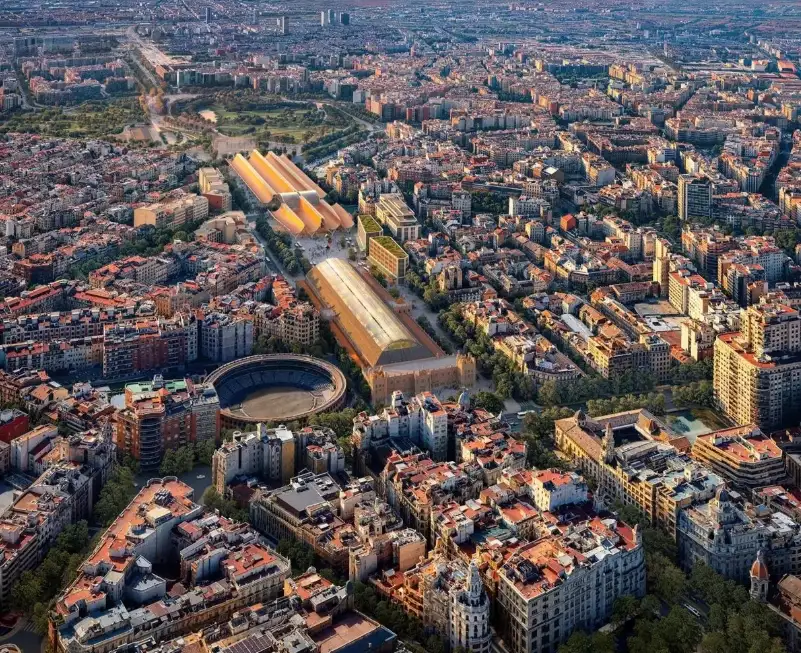
What Sener is proposing is a fully underground through-station — approximately 1,200 metres long — situated between Gran Vía Germanías and the current Joaquín Sorolla station, which would be decommissioned.
Unlike the existing Estació del Nord, where trains terminate and must reverse, the new station would be pasante: trains enter from one end and exit the other, connecting the north and south of the city without manoeuvring. It will consolidate AVE high-speed services, Cercanías commuter lines, the Mediterranean Corridor and long-distance rail, with direct integration into Metrovalencia, tram and urban buses.
However, construction is not expected to begin within this decade — the design phase alone runs to 2030.
The biggest urban development in the city’s history
Between the end of the Jardín del Turia and the Marina Real lies 380,000 square metres of former industrial and railway land that has, for generations, cut Valencia off from its own waterfront.
It will become the PAI del Grau — the urban development plan for this zone provides for 3,200 new homes, of which 780 will be publicly protected housing and close to 300 will be built directly by the city council for affordable rental.
There will be 160,000 square metres of green space, including a continuation of the Jardín del Turia extended all the way to the sea. A new bridge will connect the neighbourhoods of Moreres and Nazaret to El Grau and the rest of the city. The total private investment in urbanisation infrastructure exceeds €150 million, making this the largest residential urban development ever carried out in Valencia.
Beyond the housing, the plan includes 45,000 square metres of public facilities — space earmarked for schools, health centres and cultural and sports infrastructure — and a 94,000-square-metre technology hub to complete La Marina’s existing cluster of innovation companies.
A shopping complex the size of a small town
South of the city, next to the Hospital La Fe and the V-30 and V-31 motorways, a new district called Turianova has been under construction for several years.
Infinity — the shopping and leisure complex planned for Turianova since 2021 — has been through several changes of ownership and multiple delays. The Murcian businessman Tomás Olivo acquired the project in summer 2025 and confirmed construction would start the following January. Works started in early 2026. The opening is planned for 2028. The total investment is €500 million.
The complex will cover over 110,000 square metres of gross leasable area and include more than 240 stores, a hotel, restaurants and leisure facilities including — if the plans hold — an artificial wave pool. There will be parking for 4,000 vehicles.
More than 55% of the commercial space is already leased, with confirmed tenants including Cines Yelmo and a bowling venue.

El Kremlin gets a second life
You may have noticed the silos — a cluster of large concrete grain silos — at the northern edge of La Patacona. Locals call them el Kremlin and they have survived more than a decade of abandonment and several demolitions plans.
In February 2026, the first demolition machinery arrived on site — though not for the silos themselves.
The project is called Vinival The plan covers 12 hectares and provides for 974 homes, of which 313 will be publicly protected. Rather than the standard orthogonal street grid, the layout takes its geometry from the surrounding huerta farmland.
Buildings are capped at eleven storeys to prevent a wall effect blocking views between the huerta and the sea, and 15,500 square metres of gardens and 3,800 square metres of urban allotments are incorporated into the design.
The silos themselves will not be demolished. They are to be restored and repurposed as the central communal space of the new neighbourhood, with potential uses spanning culture, sport, gastronomy and commerce. Full construction timelines depend on soil decontamination and approval of the urbanisation project, which are still pending.
See the renders here
Two more on the horizon
On the western edge of the city, Nou Mestalla — the stadium Valencia CF began building in 2007, ran out of money for in 2009, and left as a concrete skeleton for sixteen years — is finally taking shape. Construction resumed in January 2025 (they gor financing from Goldman Sachs and La Liga, itself). Capacity will be 70,044 and the opening is scheduled for summer 2027.
At the other end of the city, at the Marina, a different kind of landmark is planned. In December 2025, the mayor and the president of the Port Authority jointly announced a 108-metre tower — approximately thirty floors — to be built on what is currently a car park opposite The Terminal Hub. Named Baluarte de la Marina, it will be mixed use: offices, hotel, retail.
No architectural design has been made public yet but at 108 metres it will sit just below the current city tallest — Torre de Francia at 115 metres.