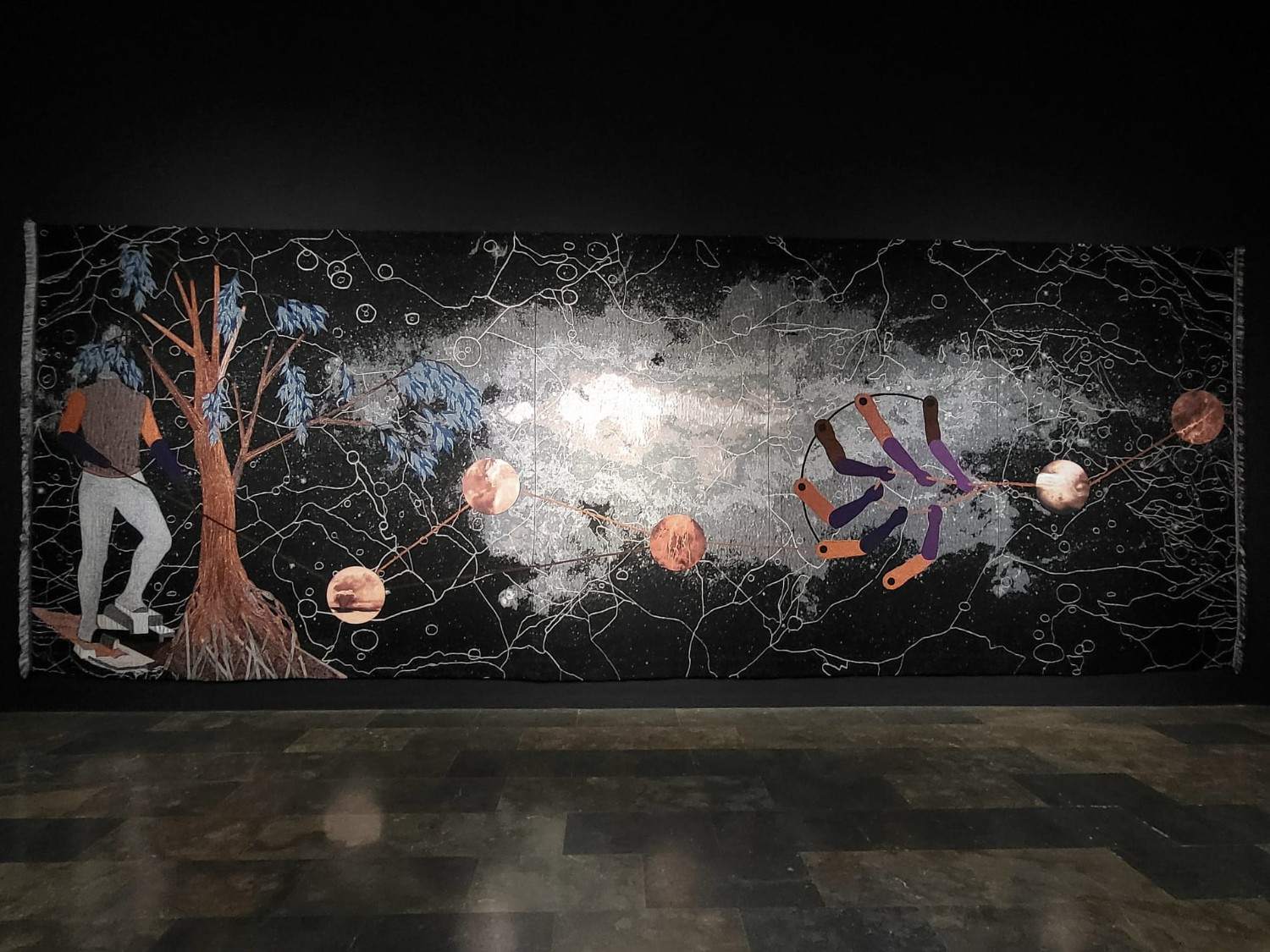
This week, from 17 to 25 September, close to twenty galleries and exhibition spaces across Valencia throw open their doors — together, on purpose, at the same time — for Abierto Valencia, the city’s 14th annual contemporary art week organized by LAVAC, the Asociación de Galerías de Arte Contemporáneo de la Comunitat Valenciana. There’s a joint night on the 18th, guided gallery-walk routes threading through the city center, talks, performances, and a closing party at the Museu de Belles Arts. It’s free, it’s citywide, and it’s easy to treat as one more thing on the cultural calendar.
But look past the exhibition listings and there’s a more interesting story: this week is a snapshot of exactly where serious money — private and public — is flowing into Valencia’s art world right now. Here’s what’s actually happening behind the gallery doors.
Hortensia Herrero and the palace Mercadona rebuilt
This summer I was in The Centro de Arte Hortensia Herrero for the first time, and I was astonished not only by the collection. The CAHH now holds work by Anselm Kiefer, Georg Baselitz, Andreas Gursky, Anish Kapoor, and Olafur Eliasson, among others, with several pieces made specifically for the building.
Never a better moment for this quote: “Look on my works, ye Mighty, and despair!”
The building itself is no small prize. A 17th-century building that sat in disrepair until the Fundación Hortensia Herrero spent seven and a half years and around €40 million on the restoration and artistic interventions. In 2024, the New York Times named it one of its 52 places to go, the only Spanish site on the list.
I believe by now long-term residents are very familiar with Herrero, but just in case you don’t, she is a Valencian VIP worth knowing. The vice-president of Mercadona and the wife of its founder, Juan Roig — a name that needs no introduction to anyone who’s shopped here.
Since starting her foundation in 2012, she’s funneled money into restoring some of the city’s most damaged heritage sites: the Iglesia de San Nicolás (its recovered Baroque frescoes won a Hispania Nostra award), the Santos Juanes church, and the Colegio del Arte Mayor de la Seda, before the CAHH itself. Since 2012, the foundation has put €66 million into cultural, heritage, and social projects, according to its 2025 annual report.
And just your luck, this week, the CAHH is opening its “Sala Abierto València” for free public access for the full nine days — no ticket, no cita.
It’s not just her: a second Valencia fortune is doing the same thing
There is another major private art space that runs on the same playbook as CAHH: Bombas Gens, funded by another familiar (though less conspicuous) local retail fortune: José Luis Soler Vila, co-owner of Ubesol (the company behind Mercadona’s own Deliplus and Bosque Verde house brands, what a coincidence!).
The Per Amor a l’Art Foundation is responsible for running the art center, social and research programs, as well as holding the 1,300-piece contemporary art and photography collection.
The venue is, of course, part of Abierto Valencia, showing the Colección José Luis Soler on Saturday the 19th.
What I find interesting is that neither of these foundations answers to a city council or a ministry. Two of Valencia’s most recognizable household names are quietly the ones deciding which crumbling palace gets restored and which art collection the city gets to see for free. That’s not local government investing in culture. That’s local retail money doing it instead, and doing it at a scale most public budgets couldn’t even think of.
But they are trying to be part of the conversation.
Private philanthropy isn’t the only money moving. The IVAM (a public institution) is holding a press conference specifically to announce which works it’s acquiring during Abierto Valencia. Private collectors are also expected to make acquisitions of their own throughout the event days, although we don’t yet have confirmed figures for this edition.
Where you fit in all of this
Still, there is a piece of that cake you taste. There’s exactly one decision this week where your opinion counts for as much as a collector’s checkbook. Two of the week’s prizes — Mejor Exposición (Generalitat Valenciana) and Mejor Artista (Ajuntament de València) — go through a professional jury. But the 7th Premio Cervezas Alhambra, for an emerging artist and their gallery, is decided by public online vote and handed out at the closing ceremony on Sunday the 20th.
All in all, next week’s event promises to be a chance to watch where Valencia’s money — and, for once, your own vote — actually goes: a rare combination of events.