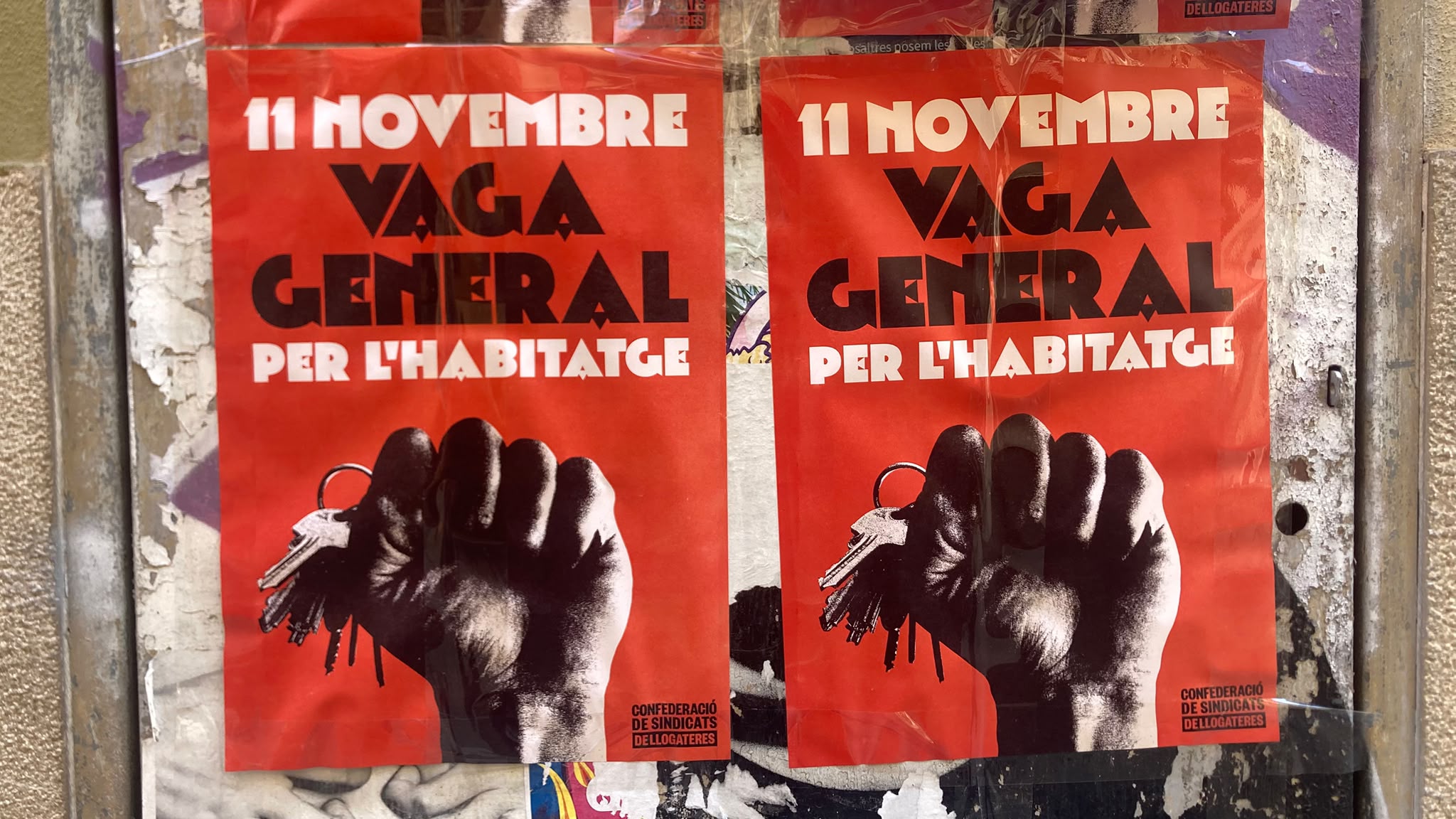
Last Tuesday, during a board game night in a bar, a young woman came over to our table with a stack of flyers. She asked politely if she could leave a few with us. We said yes, and she carried on around the room, leaving them on every table.
Before she left, I caught her and asked her to translate a few words on the flyer that were in Valencian. She explained each one with real passion, then hurried for the door, calling back over her shoulder: “Nos vemos en la huelga.” See you at the strike.
On Wednesday 11 November, Spain holds its first general strike backed by both of its major unions since 2012. Here’s what it’s about, and what it means for Valencia.
The short version
- When: Wednesday 11 November, from 00:00 to 24:00. In workplaces that run shifts, the strike can begin with the first shift before midnight and end with the last one, even if that runs into Thursday.
- Where: Across Spain, in both the public and the private sector.
- Who’s calling it: CCOO, UGT, CGT, CNT, Intersindical, Co.Bas, Solidaridad Obrera, the actors’ union and the Confederación de Sindicatos de Inquilinas (the national tenants’ union federation). In Valencia, they are joined by COS, the Sindicat de Llogateres, the PAH (Plataforma de Afectados por la Hipoteca) and EntreBarris.
- The slogan: Salarios, vivienda y precios: wages, housing and prices.
- Why it’s a big deal: It is the first statewide general strike called jointly by Spain’s two largest unions, CCOO and UGT, since November 2012.
- Watch out for the trains: The train drivers’ union Semaf has called a separate full-day strike at Renfe on Tuesday 10 November and partial stoppages on Thursday 12 November, so rail travel could be disrupted for three days in a row.
Why it’s happening
Wages that haven’t kept up
The unions’ core argument is that pay has fallen behind the cost of living. As Atika reported last week, INE figures show consumer prices in Spain rose 23.3% between January 2019 and September 2025, while wages rose by about 10%.
On pay, UGT and CCOO are asking for:
- general pay rises of 4% to 7% through collective agreements;
- a minimum wage rise of at least 7% in 2027;
- deals that unblock collective bargaining, which has stalled in several sectors;
- shorter working hours. The organisations calling the strike don’t all agree on how far these should go.
Housing
Housing is the issue that started this strike. CCOO PV says the strike is meant to put living and working conditions at the centre of political and economic priorities. The demands, as set out on UGT’s strike page, include stopping property speculation, expanding public and protected housing, and stronger protection against evictions.
The pressure is particularly acute here. In Valencia’s housing crisis: who owns the empty buildings of El Carmen?, Atika found that the Bank of Spain estimates a shortfall of about 750,000 homes nationwide between 2021 and 2025, with more than half of it in six provinces that include Valencia and Alicante. Social rental housing makes up about 1.7% of Spain’s housing stock. And in the CIS survey for October, 55.7% of respondents named housing as one of the country’s main problems. Housing has topped that list for 21 months in a row.
Why the timing is controversial
Spain votes in a general election on 29 November, less than three weeks after the strike. Critics say that makes the strike political, a way to put pressure on voters right before the election. The unions say it isn’t: housing and wages have been problems for years, whoever is in government.
Business groups are against it. Spain’s main employers’ organisation threatened to take the strike to court, then backed down. Not everyone on the business side agrees, though. Of the two main associations of self-employed workers, one opposes the strike (ATA), and the other supports it (UATAE).
Does everything shut down?
A general strike doesn’t close anything automatically. Hospitals, emergency services and public transport have to run minimum services set by the authorities. Everywhere else, from schools and health centres to shops, banks and public offices, what happens depends on how many staff decide to join in. Some places will work as normal, some will be short-staffed and some will close for the day. If you have an appointment, a class or a booking on the 11th, it’s worth checking beforehand. Universities are planning around it too: the Universitat Politècnica de València (UPV) has already adjusted its academic calendar because of the strike.
How a strike works in Spain
In Spain, the right to strike is a fundamental right. It is guaranteed by Article 28.2 of the Constitution, and the rules for it date back to a 1977 decree-law. It covers anyone working for an employer, whatever their nationality. In practice, it works like this:
- Workers don’t have to give notice. The unions give formal notice for everyone. Each employee then decides individually whether to join in, and can decide on the day.
- No one can be sanctioned or dismissed for striking.
- Strikers don’t get paid for the hours they’re out. Employers can also deduct a proportional share of bonuses and extra pay instalments. That’s why many people join for only part of the day, or not at all.
- Social Security contributions are suspended for the hours on strike.
- Employers can’t replace strikers. They can’t bring in other staff to cover, and they can’t ask strikers to work from home instead.
- Essential services keep running. In health, public transport, emergency services and some public services, the authorities set minimum services, and the staff assigned to them have to work. That’s why buses still run and hospitals stay open during a general strike, just with fewer staff.
If you’re not striking but can’t get to work because of the disruption, that doesn’t count as striking, and your employer doesn’t have to pay you for those hours. It’s worth telling your employer early and keeping proof of any cancelled bus or train. Working from home is only an option if you both agree to it.
What happens next
The official election campaign starts two days later, on Friday 13 November, and Spain votes on Sunday 29 November. The unions say what comes after the strike will depend on how the parties respond on housing and pay. Tenants’ groups have already suggested a coordinated rent strike as a possible next step.
Whatever you make of it, Wednesday is worth watching. Housing has topped the list of the country’s concerns for almost two years, and on the 11th we’ll see how many people are ready to say so out loud. As the woman with the flyers put it: nos vemos en la huelga.