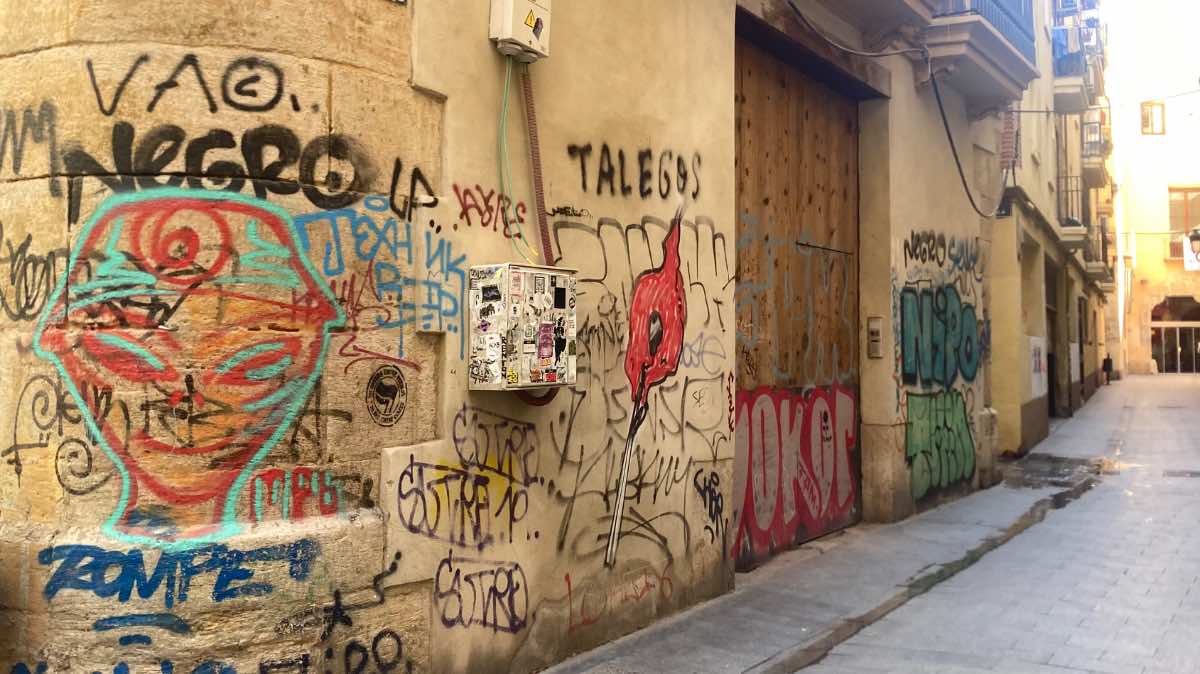
Empty palacios and shuttered buildings are a familiar sight in Valencia’s historic centre. But as housing becomes increasingly unaffordable, the mystery of who owns these properties raises bigger questions about Spain’s housing shortage.
El Carmen is at the heart of Valencia’s old city, which makes it popular for visitors and locals alike. The walls here are an ever-changing gallery of colorful street art. Narrow alleys lead to historic churches and seemingly abandoned palacios. Tourists flock along the main roads, led by flag-waving guides. Residents bypass the crowds by ducking into side streets, including the quiet corner where I live.
Some savvy guides detour through my street, stopping to admire my neighbor’s beautiful mural: blue waves inspired by Sorolla’s dappled seascapes. They point out all the hidden details, but they also unfailingly remark on the number of seemingly unoccupied or abandoned buildings in the neighborhood. Outside my window, I can see at least three such buildings that have been modernized and renovated but remain shuttered for reasons unknown.
One particular guide repeatedly makes an audacious claim about the building across from me. It is one of several properties owned by one of Valencia’s wealthiest women, the guide says, who leaves them empty while waiting for prices to rise.
Is this true? I don’t know. I’ve asked my neighbor, who was born and raised in our building. And this is news to her. Though she admits it’s hard to know who owns what in the neighborhood anymore. Confirming it would require digging into property registry records.
But with the housing protest camped in the Plaza del Ayuntamiento for more than a month, I thought I would at least look into the statistics behind Spain’s housing crisis, and Valencia’s in particular.
What the numbers tell us
From what I’ve found, the main problem is that Spain isn’t building enough homes to keep pace with household growth. In its 2025 Annual Report, the Bank of Spain estimated that the gap between new housing construction and household growth reached around 750,000 homes between 2021 and 2025. More than half of that shortfall was concentrated in just six provinces, including Valencia and Alicante.
Spain also has surprisingly little public and social housing. According to Housing Europe, public social rental housing accounts for only about 1.7% of the housing stock. Including all protected housing (VPO), the figure rises to around 3.4%. The Comunitat Valenciana isn’t doing much better. According to the UPV Housing Observatory, protected housing accounts for only 3–5% of new construction in the region.
For those who dream of a home of their own, especially the younger generations, the math simply doesn’t work.
According to the Housing Observatory Chair at the Universitat Politècnica de València (UPV), the average price of new-build housing in Valencia city and its metropolitan area has more than doubled since 2019. Meanwhile, between January 2019 and September 2025, consumer prices in Spain rose by 23.3%, while wages increased by around 10%.
And a 2025 study by real-estate platform Idealista found that renting a typical two-bedroom flat in Valencia required around 40% of average household net income. Buying required around 27%.
Who owns these properties?
But what about all those empty properties that seem to be languishing in Valencia, especially in my Ciutat Vella neighborhood? And how many are owned by large property holders who leave them sitting vacant?
According to the INE’s 2021 census, as analyzed by El País data journalist Kiko Llaneras, around 9% of homes in Valencia city were classified as vacant. But, as Llaneras points out, even the official figures need to be treated with caution. The INE used electricity consumption to estimate vacancy, a method that can classify second homes or properties used occasionally as empty.
As for who owns them, it’s harder to say. An elDiario.es analysis of Cadastre data found that around 102,500 vacant homes in the Comunitat Valenciana belonged to owners with more than ten properties. That’s about 3.2% of the region’s total housing stock.
Among the 40 owners with more than 50 vacant homes, all but two were companies or other legal entities. One of the two individual owners was in Valencia city, with 318 vacant homes. The Cadastre data was anonymised, so the owner’s identity is not publicly available.
Zoom out from the numbers and it’s clear why the public is frustrated. With the Nov. 29 general election approaching, the CIS’s October survey found that 55.7% of respondents named housing as one of the country’s main problems. It had topped the list for 21 consecutive months.
Still, while the data helps to understand the problem, it doesn’t say who owns the stately but seemingly empty buildings on my street. The tour guide’s explanation makes it easy to imagine a villain. It is easier to blame one wealthy property owner, or a political party, than to confront the complicated roots of a systemic housing shortage.
It’s a good yarn, though. And I can’t help wondering about it every time I look at those shuttered windows across the street.