Everyone in Valencia seems to know where the money lives. But how much do the people on your street actually earn? Now there’s official data to answer that, and we went through every corner of the city to find where its highest and lowest earners live.
INE’s Household Income Distribution Atlas, built from tax records and released on 19 October 2026, covers 2024 incomes. It splits Valencia into 603 census sections of about 1,400 residents each, close enough to street level to see which blocks earn what.
Two caveats. First, this is income, not wealth: a retired couple in a paid-off flat on Gran Via may own a fortune and still show a modest income. Second, these are averages. Every area has richer and poorer households, so the figures describe a neighbourhood, not the people in your stairwell.
The main figure we use is average net income per person: what households take home after tax and social security, divided by everyone who lives there, children included. In 2024 that came to €16,944 across Valencia city, up 5.1% on the year before.
Valencia vs Spain
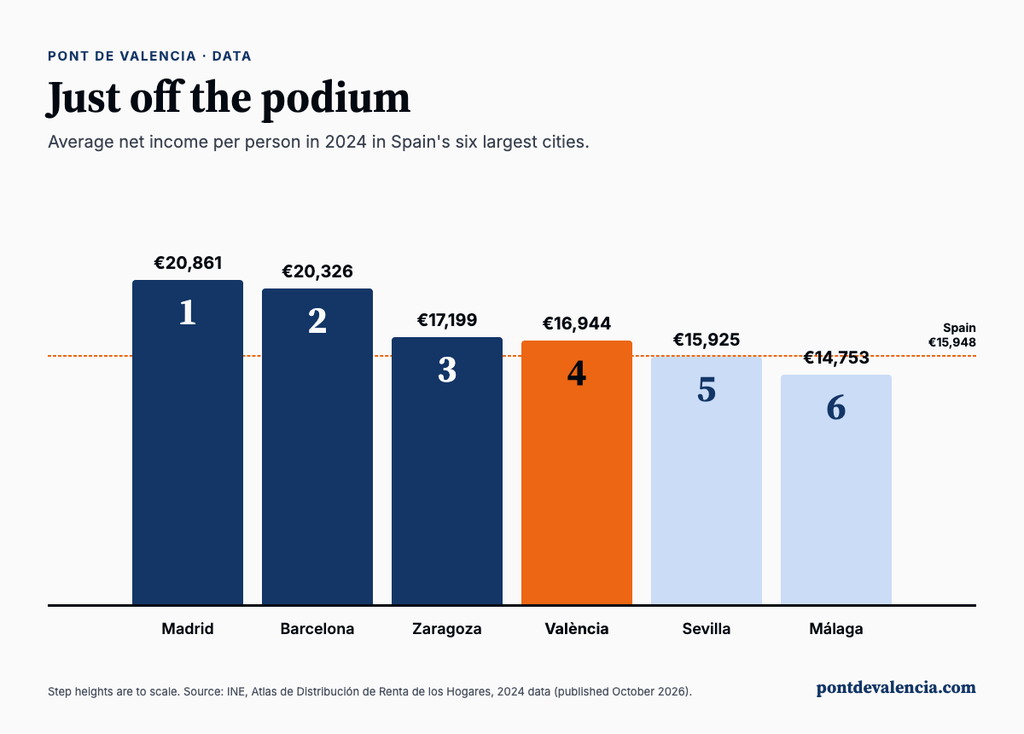
On paper, Valencia is a comfortably average Spanish city. Its residents take home about 6% more than the national figure of €15,948 a head, and well over the Comunitat Valenciana’s €14,335. Among Spain’s six largest cities it comes fourth: behind Madrid, Barcelona and, by a whisker, Zaragoza, but ahead of Sevilla and Málaga. In 2024 its incomes even grew a little more slowly than the country’s, 5.1% against 6.1%.
That middle-of-the-table average is exactly what makes the city worth a closer look. It blends streets that rank among the wealthiest in Spain with blocks that earn less than any Spanish town of more than 2,000 people. And they are often closer together than you would think.
District by district
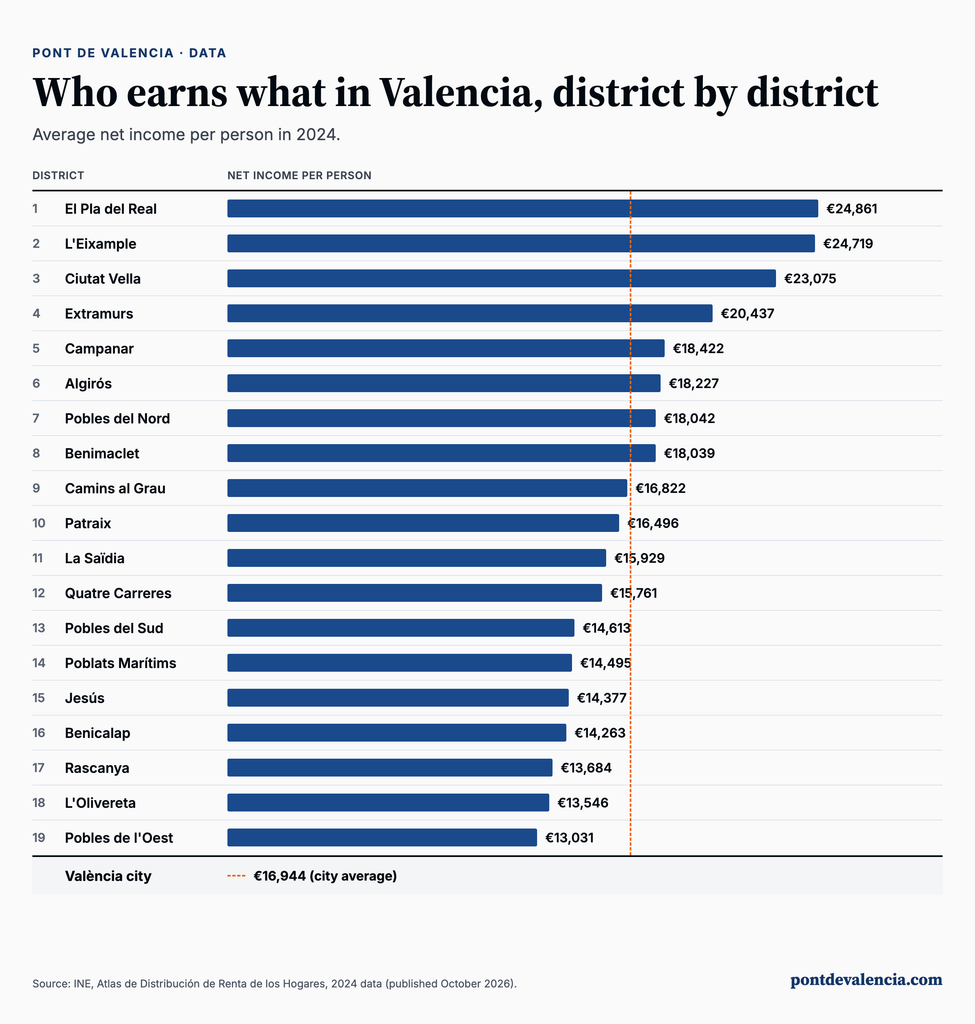
Inside the city, that average splits fast. El Pla del Real takes the top spot at €24,861 per person, but only by a nose: L’Eixample is €142 behind. Count by household and Pla del Real pulls clear, €64,550 to €59,551, thanks to bigger households.
Ciutat Vella rounds out the podium. After that the city falls away and bunches between €13,000 and €18,500, down to Pobles de l’Oest (Benimàmet and Beniferri) at €13,031, barely half of Pla del Real.
Averages hide who actually lives there, so INE also counts residents on low and high incomes. Take someone living alone: by INE’s yardstick they are on a low income if they take home under about €12,000 a year, and a high income if they take home over about €40,000 (the thresholds rise for bigger households). In Pla del Real, one resident in three is on a high income and one in nine on a low one. In L’Olivereta it flips: more than one in four on a low income, barely one in seventeen on a high one
Street by street: Where The Money Is
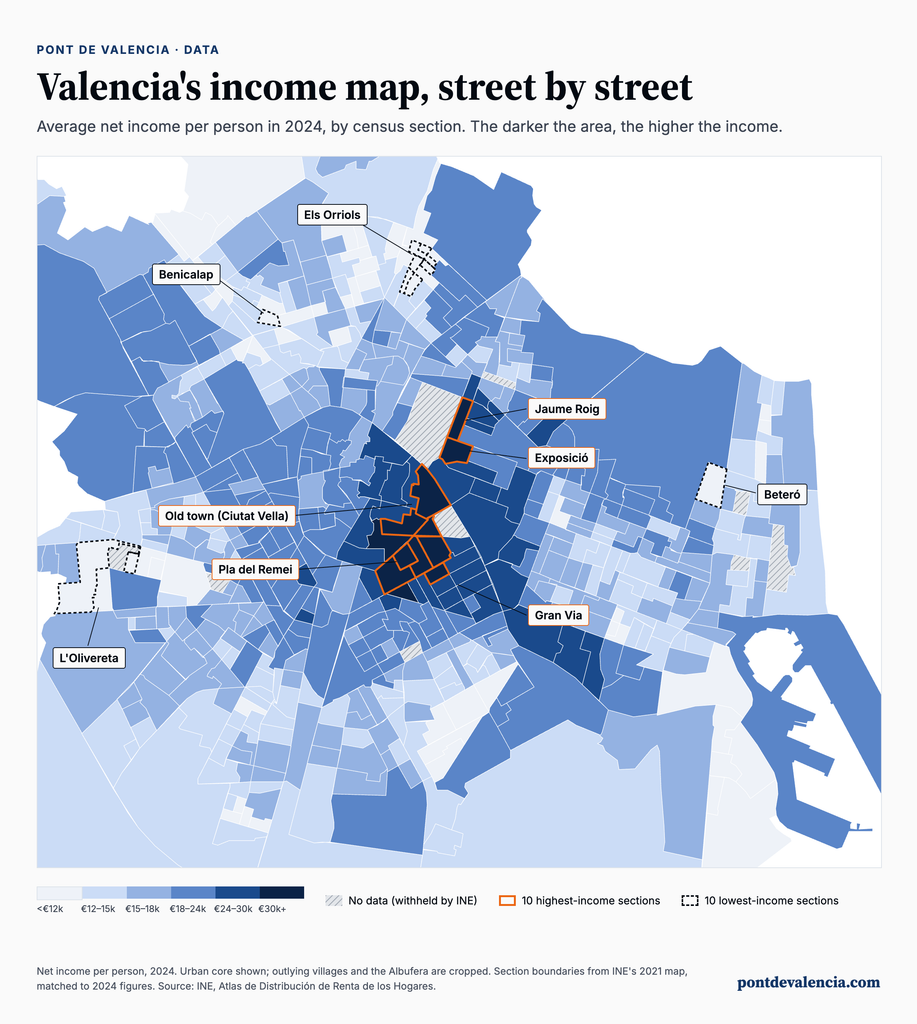
Zoom in street by street and the money hugs the old town’s eastern edge. Pla del Remei is Valencia’s richest barrio by a distance, holding half of the city’s ten highest-earning sections in the grid around Cirilo Amorós, Félix Pizcueta and Colón. Across the Turia, the blocks around Plaza de la Legión Española in Exposició match it: households average €112,163, and six in ten residents are on high incomes. Both hit INE’s national cap of €40,089 per person, a ceiling reserved for the top half-percent of Spain’s census sections, so the real figures are higher still. Ciutat Vella’s modest district average hides corners almost as rich, around the Glorieta and in Sant Francesc, while Gran Via sits a notch lower at €27,000 to €34,500 a head. And a couple of surprises break the pattern: pockets of Benimaclet and Arrancapins out-earn parts of Gran Via.
Where it isn’t
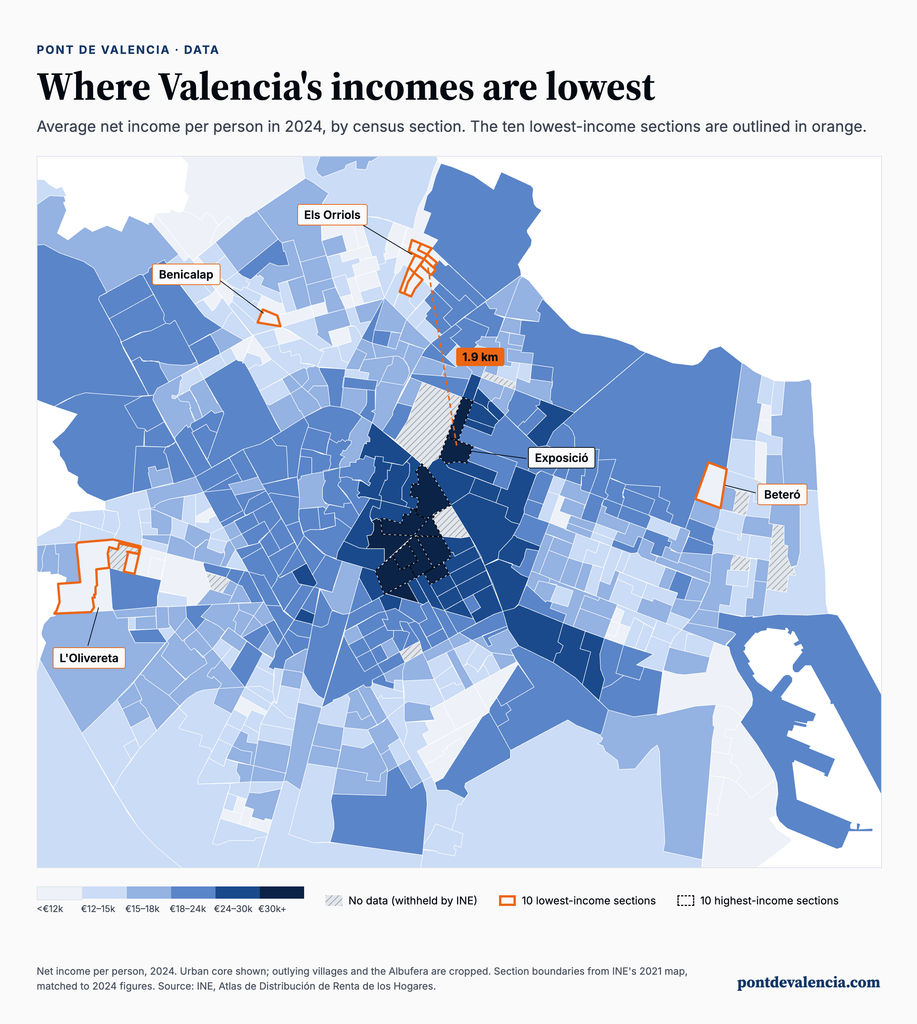
The city’s lowest incomes are just as tightly packed. All six of Valencia’s poorest census sections sit in Els Orriols, in Rascanya, around Padre Viñas and San Juan de la Peña, where residents take home as little as €8,439 a head, less than in any Spanish town of more than 2,000 people, and roughly half are on low incomes. Tres Forques and La Fuensanta, in L’Olivereta, come next, with smaller pockets in Benicalap and in Beteró, on the seafront district it shares with El Cabanyal. What makes the gap striking is how close it is: Orriols’ poorest blocks are just 1.9 km from Exposició’s richest, where households earn more than four times as much.
Beyond the city: the suburbs out-earn Valencia
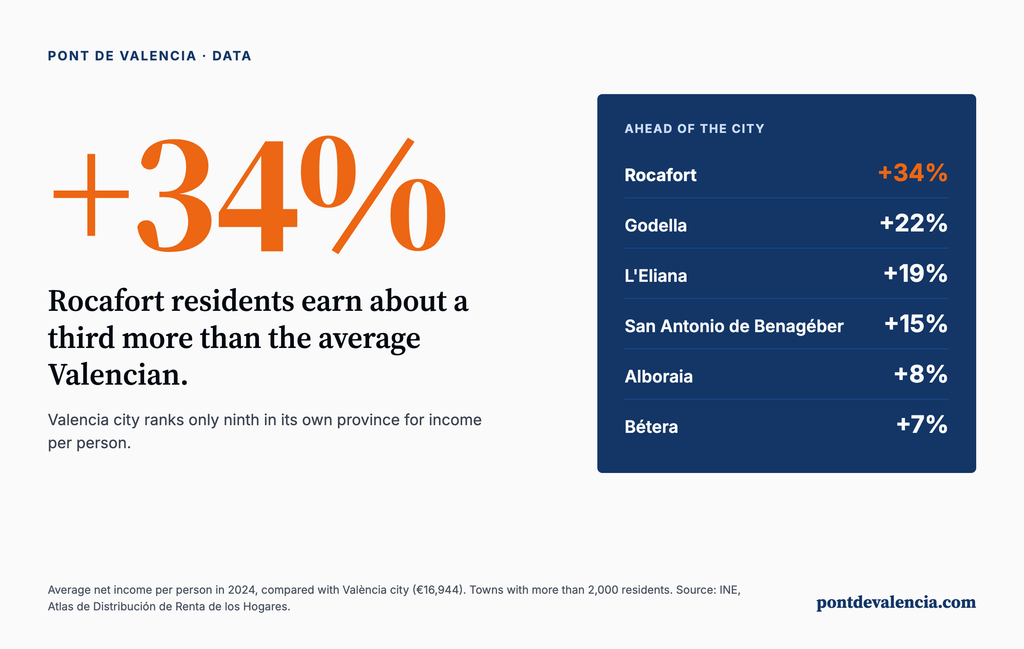
Step outside the city limits and the picture shifts again: Valencia only makes ninth place in its own province. The money has drifted north, to Rocafort, a town of under 8,000 people where residents earn about a third more than the average Valencian. Its households even out-earn Pla del Real’s. Godella, L’Eliana and San Antonio de Benagéber round out the top four, with Alboraia and Bétera close behind.
The same caveat applies here: these are averages across whole towns, and INE publishes the same street-level breakdown for each of them.
The bottom line
So, how rich is your neighbour? On average, a little richer than most people in Spain. But in Valencia the average tells you very little about your own street. The city holds blocks that rank among the wealthiest in the country and others that earn less than any Spanish town of more than 2,000 people, often just a short walk apart.
Income isn’t wealth, and these figures can’t tell you who lives next door. INE updates the atlas every year, so we’ll be watching whether the gap narrows. In the meantime, find your own barrio on the maps above. Did it surprise you?
Related Articles
Renting in Valencia: Contracts, Deposits and What Landlords Can’t Ask
Buying a Home in Valencia as a Foreigner: Costs, Taxes and Steps