
Last checked: 8 October 2026
This guide is general information, not legal or tax advice. Rules and rates change, so check your case with a lawyer or gestor before you sign anything.
The short answer: Anyone can buy property in Spain, whatever their nationality. You’ll need a NIE first and, in practice, a Spanish bank account. Budget roughly 10–14% on top of the price for taxes and fees: in the Comunitat Valenciana, a resale home carries 9% transfer tax (ITP), and a new build 10% VAT plus 1.4% stamp duty. Once you own, you’ll pay IBI to the town hall every year. Buying a home no longer gets you a residence visa.
Key Facts
- There is no nationality restriction on buying property in Spain, but you need a NIE to sign the deed and pay the taxes.
- Resale homes: 9% ITP in the Comunitat Valenciana, rising to 11% on the part of the price above €1 million. Buyers under 35 and some families pay reduced rates. (Guía Fiscal)
- New builds: 10% VAT (IVA) plus 1.4% stamp duty (AJD) on the deed, instead of ITP. (Guía Fiscal, same page)
- Cash is capped at €1,000 when a business or professional is involved, so you can’t pay a developer, an agency or a lawyer €1,000 or more in cash. For non-residents who aren’t acting as a business, the cap is €10,000. Between two private individuals the cap doesn’t strictly apply, but the deed has to record how the price was paid, so in practice everything goes by bank transfer or banker’s draft (cheque bancario). (El Español, citing Ley 11/2021; idealista)
- The “golden visa” for property investors ended on 3 April 2025. (La Moncloa)
- In Valencia city, IBI for 2026 is 0.5784% of the property’s cadastral value: about €1,157 a year on a cadastral value of €200,000. (Guía Fiscal)
- Non-residents who keep a home they don’t rent out also pay tax on “imputed income”, filed on Modelo 210. (Agencia Tributaria)
After a year or two of rent rises and landlords who won’t fix the boiler, many people here start doing the maths on buying. Spain makes it straightforward for foreigners to buy, with no special permits and no nationality rules. What catches newcomers out is the order of the steps, and the costs that sit on top of the asking price.
Step by step
- Get your NIE. You can’t sign a deed, pay the taxes or, usually, open a resident bank account without one. Get it at a Spanish consulate before you arrive, or here through the extranjería appointment system.
- Open a Spanish bank account. It isn’t strictly required by law, since you can pay by international transfer as long as the source of the funds can be verified. But the deposit, the final payment, the taxes, and later your bills and any mortgage all run far more smoothly from a Spanish account.
- Pay the arras (reservation deposit). This takes the property off the market. Under the most common type, arras penitenciales, you lose the deposit if you pull out, and the seller pays you double if they do. (Código Civil, art. 1454) Always put it in writing.
- Sign at the notary. The sale happens through a public deed (escritura) signed in front of a notary.
- Register the property. Registering the deed at the Registro de la Propiedad is what makes the home legally yours against any third party. A gestoría usually handles this and the tax payments.
What it costs on top of the price
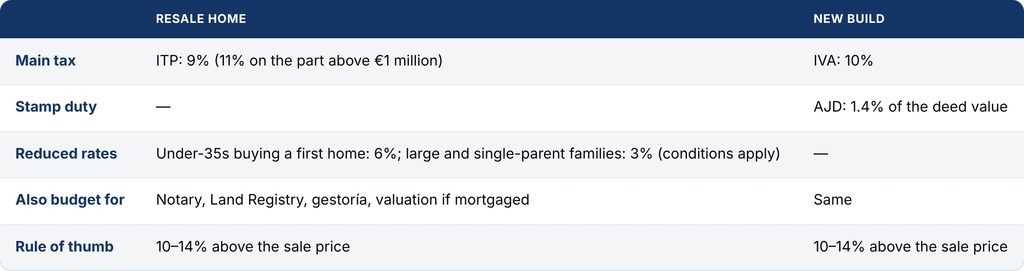
For example, on a €200,000 resale flat at the general rate, the ITP alone comes to €18,000.
Annual taxes once you own
IBI (Impuesto sobre Bienes Inmuebles).
Every owner pays IBI each year, resident or not. Each town hall sets and collects its own, so a flat in Paterna, Alboraya or Torrent follows that town’s rates and deadlines. In Valencia city, the 2026 rate is 0.5784% of cadastral value, payable between 1 April and 1 June or in three direct-debit instalments (April, July and October). For questions, contact the Oficina de Gestión Tributaria Integral through sede.valencia.es.
Large-family discount.
In Valencia city, large families get 60% off the IBI on their main home, or 90% in the special category. Foreign residents qualify too. You need:
- The Generalitat’s large-family title (título de familia numerosa). Spanish law (Ley 40/2003, art. 2) defines a large family as “uno o dos ascendientes con tres o más hijos”: one or two parents with three or more children. Some two-child families also qualify, for example when a child has a disability or a parent has died. Five or more children puts you in the special category. Foreigners can get the title as long as all the family members it covers live in Spain.
- Padrón registration at the property, which must be your main home.
The discount starts the year after you apply.
If you’re not yet a tax resident.
If you buy before you move, or keep a second home here, Spain taxes non-residents on an “imputed income” from property they don’t rent out. It’s calculated as 1.1% or 2% of the cadastral value, taxed at 19% for EU, Iceland, Norway and Liechtenstein residents and 24% for everyone else, and filed on Modelo 210 with the Agencia Tributaria. Once you’re a Spanish tax resident, this no longer applies in the same way, and it’s worth asking a gestor how your situation fits.
Where to look
The main portals for buying, as for renting, are idealista, fotocasa and pisos.com. Agency and private listings appear on all three, so cross-check them for a fuller picture of what’s available.
Bank-owned homes and public auctions. Beyond the portals, there are cheaper routes, each with its own rules:
- Aliseda is a property servicer that sells homes, including ones repossessed by banks (pisos de bancos). It’s an ordinary purchase: anyone can buy, foreigners included, with a NIE, like any property in Spain.
- Escrapalia, run by Surus, holds online auctions of property and other assets for public bodies and companies. You register and verify your identity on the site, and many lots ask for a refundable deposit. It doesn’t publish which IDs it accepts, so check before you bid. Either way, you’ll need a NIE to sign at the notary.
- Hacienda (the Agencia Tributaria) auctions seized property on the BOE auction portal. Foreigners can bid, but registration needs a NIE plus a digital certificate, or Cl@ve obtained in person or with a certificate. Cl@ve registered by invitation letter isn’t accepted. If you don’t have a NIE, you can take part through a representative based in Spain.
- Social Security (the TGSS) auctions seized property on its own auction website. You register online and pay a deposit to bid. Registration asks for your DNI or NIE, so foreign residents can take part.
Auction homes can be bargains, but you usually can’t view them. Some are occupied, and some carry debts or charges (cargas) that pass to the buyer. Before bidding, get a nota simple from the Land Registry and read the auction’s terms, ideally with a lawyer.
FAQ
Yes. There are no nationality restrictions. You need a NIE to sign the deed and pay the taxes.
For a resale home, 9% ITP on the price (11% above €1 million). For a new build, 10% VAT plus 1.4% stamp duty. Notary, registry, and gestoría fees come on top.
Not by law, but in practice it makes every payment, from the deposit to the annual taxes, much easier.
No. The golden visa for property investors ended on 3 April 2025.
With the usual arras penitenciales, you lose your deposit. If the seller pulls out, they pay you back double.
IBI is the annual property tax charged by the town hall. In Valencia city it’s 0.5784% of the cadastral value in 2026.
Related Guides
- New in Valencia: Guides for Settling In
- Renting in Valencia: Contracts, Deposits, and What Landlords Can’t Ask
- NIE vs TIE: What They Are and How to Get a Cita in Valencia
Sources
- Guía Fiscal — ITP and AJD in the Comunitat Valenciana, 2026
- Guía Fiscal — IBI in Valencia, 2026
- El Español — Cash payment limits in 2026
- La Moncloa — End of the golden visa (2 April 2025)
- Agencia Tributaria — Imputed income for non-residents
- BOE — Código Civil
- Ayuntamiento de València — Sede electrónica
- BOE — Ley 40/2003, de Protección a las Familias Numerosas
- Agencia Tributaria — Registering to bid in auctions
- El Independiente — How Social Security property auctions work
- Escrapalia — How to take part in a property auction