Bon dia, València. Today, we’re talking about Nou d’Octubre.
What is Nou d’Octubre?
On October 9, 1238, King Jaume I entered the city after capturing it from Muslim forces, paving the way for the founding of the Kingdom of Valencia. Every year the date is celebrated as the Day of the Valencian Community, with a civic procession, fireworks and parades.
The afternoon highlight is the Moros y Cristianos parade, a theatrical reimagining of those medieval battles. Neighborhood committees dress in extravagant costumes as either Cristianos (Christian soldiers) or Moros (Muslim forces), all competing for the crowd’s applause. It’s not historically accurate in the slightest, but it is great fun and a real celebration of community. The day has become inseparable from Valencian identity.
Why does it matter this year?
The day carries historic and symbolic weight, so it’s no surprise it gets pulled into political battles, especially with a snap election looming next month.
This year it has become a flashpoint. Protesters demanding affordable housing have camped out in Plaza del Ayuntamiento. The Mayor and City Council wanted to hold the traditional events in that same square. The civic procession, which begins and ends at City Hall, is still on. But the city has suspended the Mascletà, the thunderous midday fireworks display normally fired from the esplanade, because protesters are still occupying it.
What happens next?
The protesters have agreed to remove some of the tents to clear a path for the procession.
The moment is especially symbolic because 2026 marks 750 years since the death of Jaume I. According to the city, the sword traditionally attributed to the 1238 conquest will be carried in the procession for the first time since 1976. It travels on a cushion, borne by two municipal mace-bearers, alongside the Real Senyera, Valencia’s historic flag.
Today’s schedule:
- 12:00: Civic Procession leaves Plaza del Ayuntamiento, passes Calle San Vicente and Plaza de la Reina to the Cathedral for the Te Deum, then lays flowers at the statue of Jaume I before returning to City Hall.
- 17:00: Moros y Cristianos parade, with representatives from eleven towns hit by the October 2024 floods.
The parade goes ahead unchanged, running along Calle de la Paz, Poeta Querol and Marqués de Sotelo, and ending at the Plaza de Toros. There will be no mascletà this year, even though some official event listings haven’t been updated. Expect to see plenty of police on the streets.
What should you know?
Valencians are fiercely proud of their heritage, whatever their politics. Last night was a perfect example of the city’s diversity and its coexistence on the city’s streets.
At Plaza de la Reina, a small group of far-right activists, some draped in Spanish flags, gathered behind a buffer of police and anti-riot vehicles.
Meanwhile, the protest in Plaza del Ayuntamiento swelled by the hundreds, drawing students, politicians, ordinary residents and curious tourists. Protesters had built barricades, and some came prepared for tear gas with goggles and masks. They were also organized, holding a perimeter and managing the crowd when it spilled onto the roadway.
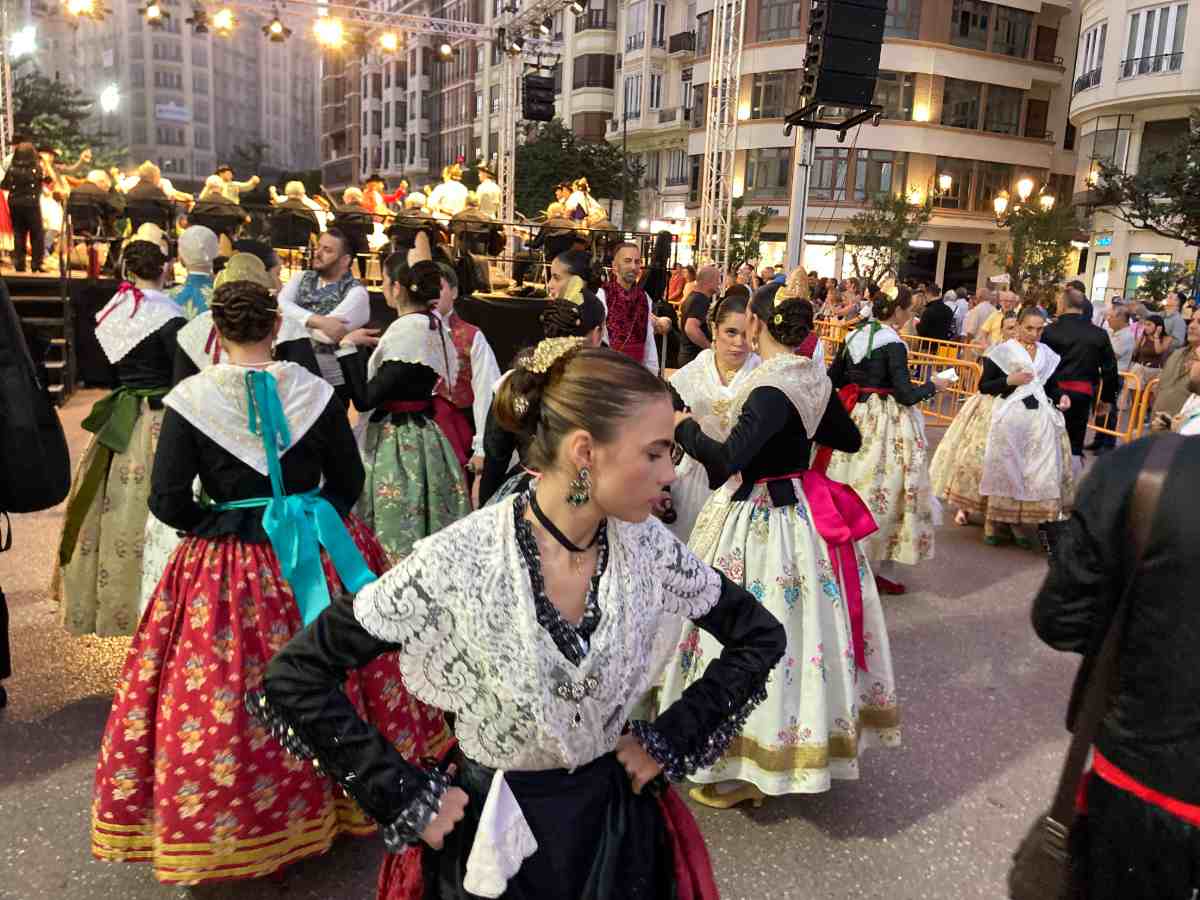
And in between? Dancing falleras, of course. As part of the official eve-of-holiday program, a stage was set up in the square for traditional Valencian music and dance. The speakers were cranked up to compete with a circling police helicopter, and the musicians and dancers didn’t miss a beat.
Twirling skirts and clapping castanets. Shouted slogans and waving flags – both Spanish and Valencian. For locals and visitors alike, it was something to see, and a very Valencian Nou d’Octubre.
Got a question you’d like answered? Send it to us at Pont de València, and it could be our next feature.
Sources: Ayuntamiento de València; Visit València; Las Provincias; Levante-EMV.