The Cost of Becoming a Fallera in Valencia.
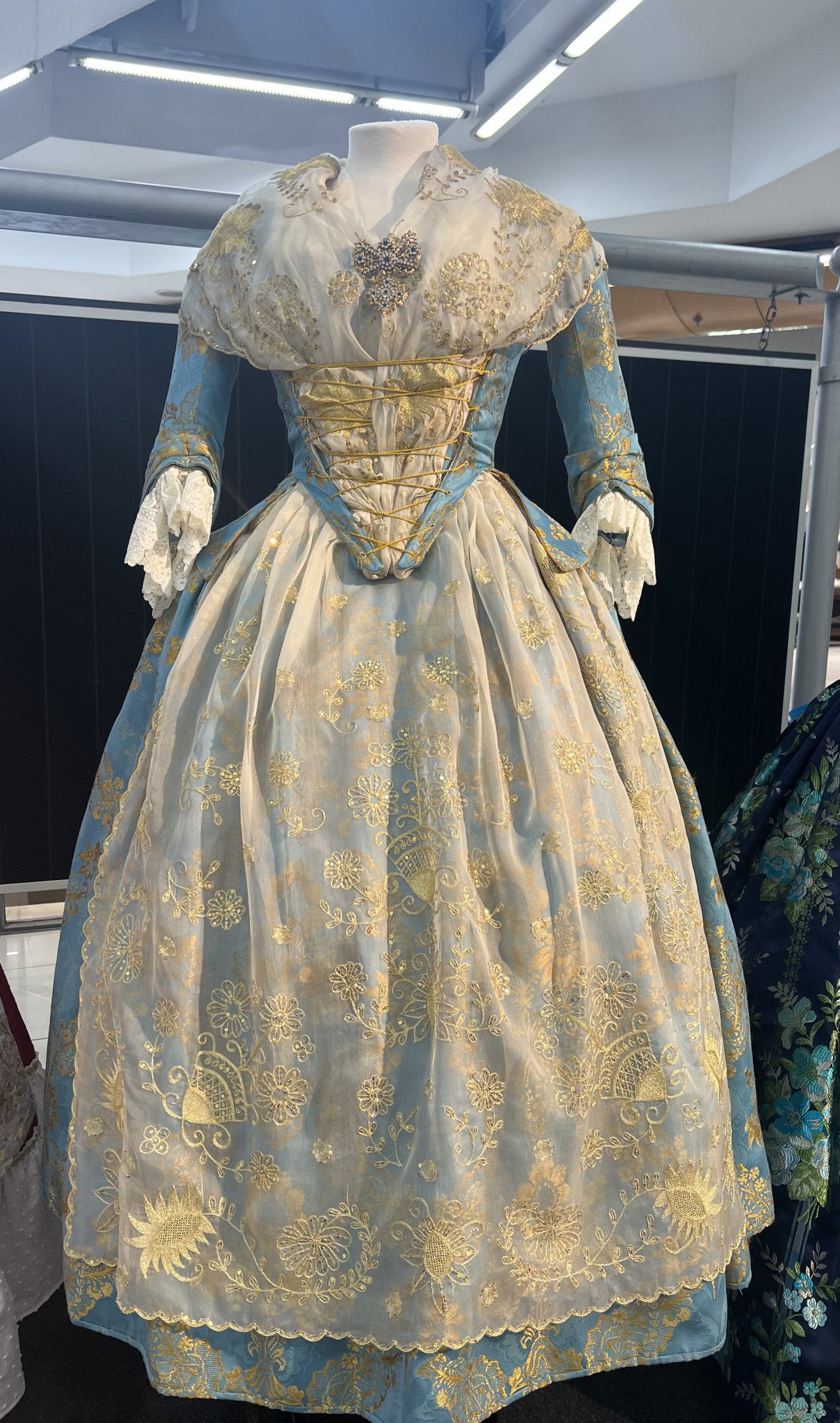
Spotting a fallera in the street always turns heads — and with good reason. It’s like watching a painting come to life. The baroque richness of the dress, the intricate details, the lush colours, the sheer elegance of the walk.
It feels like an almost inconceivable anachronism: a figure from another century quietly crossing a modern street, past cafés, traffic lights and people glued to their phones. And yet, just by passing by, she makes us feel strangely privileged to witness such a display of extravagant beauty — especially when most of us mere mortals can barely manage to put together a pair of jeans and a T-shirt in vaguely matching colours.
While you hurry to get a quick shot with your phone to share with your non-Valencian friends, have you ever wondered how that girl ended up dressed like a 17th-century socialite — and how much it actually took to get there? Surely a lot. But how much is a lot, exactly?
And if you have a little daughter, like I do, has the thought ever crossed your mind — even for a second — of one day seeing your beloved girl grow up to become a Fallera Mayor? Oh, what an honour that would be.
But honour, as it turns out, comes with a price tag — and considerable endurance.
The Selection Process to Become Fallera Mayor
It all starts with registration. Well, it almost goes without saying that the girl must already be registered as a member of a falla. Each falla commission then nominates one adult candidate and one child candidate through the JCF’s official online portal.
Valencia’s roughly 390 fallas are organised into 26 geographic sectors. Each sector holds an event where its candidates appear in traditional fallera dress and are assessed by a jury on presence, poise, charisma and conduct — not just appearance.
For the 2026 cycle, 146 candidates entered at this stage, competing for 26 finalist spots (12 for the court of each Fallera Mayor, adult and infantil). The jury observes them both in traditional Valenciana dress and in everyday clothing across formal and informal occasions.
There are several galas and events before the final selection. Over roughly two weeks, candidates face a full programme of tests: public speaking, parades, debates and cultural quizzes — in Valencian, of course (so perhaps start with the language lessons). Candidates also travel to different cities following the selection process, all at their own expense. I am told outfits cannot be repeated and candidates must always look photo-ready.
At this point, the costs break into two distinct phases: before selection (the campaign, essentially) and after — the year of office.
During the selection weeks alone, a realistic budget for an adult candidate can quickly approach €900. Cocktail dresses, everyday outfits, shoes, accessories, make-up sessions and hair appointments quickly add up. For child candidates, the figure sits closer to €500, usually paid entirely by the family — and that’s with no guarantee of being selected.
The Unofficial Costs No One Talks About
Once selected, the expenses do not necessarily stop. There are also significant unofficial costs, even for a Fallera Mayor of a regular falla.
I spoke with a fallera from a smaller commission who explained the system of gifts and invitations often expected from the Fallera Mayor’s side. “We parade every day through the street with our band heading to the Fallera Mayor’s house, where we are invited for an almuerzo or lunch. We are roughly 200 people, and the drinks never end,” she told me.
She also described how the falla itself offers gifts — often expensive complements for the fallera attire — while the Fallera Mayor reciprocates with other gifts for different groups within the commission, such as the blusones.
According to her, things operate on an even larger scale in the elite fallas — yes, there is such a thing. These are commissions from long-established neighbourhoods such as El Pilar or Convento Jerusalén, known for commissioning some of the finest artisans to craft their ninots. As an example, she noted that both Fallera Mayors and Infantil of Convento Jerusalén this year were granddaughters of businessman Juan Roig.
Queen for a Year
Once chosen, the official dress budget for the Fallera Mayor de València and her full Court of Honour (26 women in total) is publicly funded by the JCF — at least for two dresses: one main and one secondary. If additional dresses are required — for example, if the court decides to appear in coordinated colours or styles — those must be paid for by the falleras themselves.
The total contract for the 2025 cycle exceeded €125,000, covering fabrics, tailoring, mantillas, hair pieces (posticería), peinetas, and shoes — all specified in detail and crafted by accredited Valencian artisans.
However, if you are only chosen as your falla’s Fallera Mayor, the entire cost falls on the selected girl. For the fabric alone, an espolín — the traditional woven silk — can cost around €12,000 just for the cut, before tailoring, which can range from €600 to €4,000–7,000 depending on the silk style. Manteletas range from about €500 for simpler pieces to €8,000 for antique lace.
And what do they get in return for all of this?
Beyond the obvious honour, becoming Fallera Mayor means representing Fallas — a UNESCO Intangible Cultural Heritage. The women selected receive official fallera attire, traditional gold jewellery and high-quality accessories, which they keep. They also play a central role in the festival’s major events — from the Crida to the Ofrenda and the Cremà — and spend the entire year representing Valencia at cultural celebrations both across Spain and internationally.
More than Gold (yes, it is real gold) and Silk
Now you know: the option is there if you are willing to go for it. The financial aspect is certainly daunting. But more important than anything, I believe you need to truly feel the significance of Fallas — the smell of gunpowder in the air, the constant rhythm of firecrackers, and the powerful sense of belonging that the falla community brings to people’s lives.
“It’s like a wedding,” the fallera I spoke with told me. “I wouldn’t want it for myself, but my best friend is now the Fallera Mayor of our falla, and we are so happy for her. She wanted nothing else — no children, no actual wedding. She wanted this year.”
So the next time a fallera walks past you in the street, remember: you’re not just looking at a beautiful dress. You’re looking at a year of dedication, tradition, and above all, a deep belief in the cultural value of Fallas.