Why Valencians Love the Sound of Gunpowder.
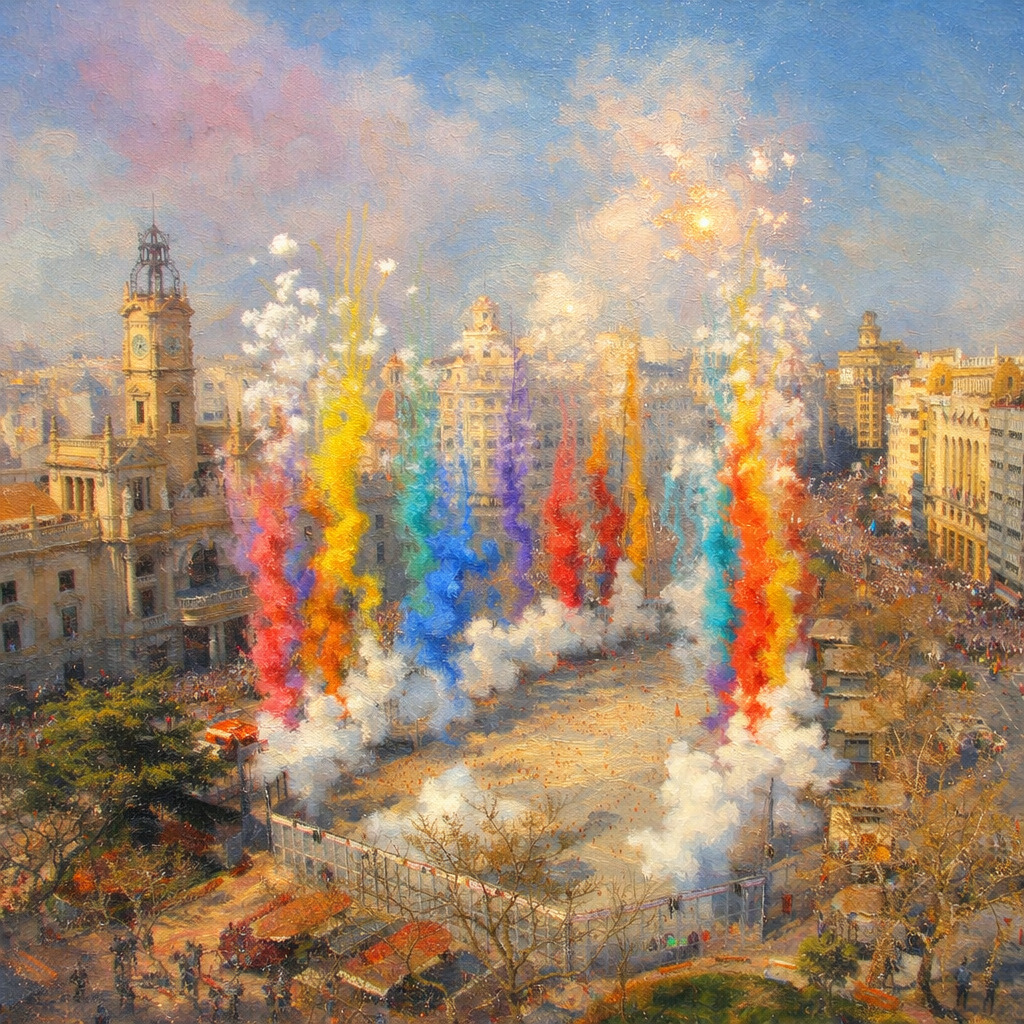
I arrived in Valencia during Fallas. Crazy, I know. After living abroad for so many years, I had completely forgotten what that actually meant — so much so that I booked our hotel right next to Plaza del Ayuntamiento.
We checked in, settled into our room, unpacked a few essentials for immediate comfort, and collapsed for a nap after nearly 24 hours of traveling. And sure enough, at 2:00 p.m., all hell broke loose.
It sounded like one of those alien-invasion counterattack scenes in a blockbuster movie. This is it, I thought. Today is the day we fight for life on this planet. My foreign husband was perplexed; the kids were terrified; the cat was nowhere to be found. It took me a moment to understand what was happening.
“Oh. It’s March. We’re in Fallas. It’s a mascletà.”
This is my third year back, and I’m now happily living just outside the city. We still get fireworks and firecrackers, of course — but at an insignificant level compared to Valencia proper. Not enough to complain about: I understand they need to.
Still, foreign residents and tourists are always mystified. The question inevitably arises: Why do Valencians love fire and noise so much?
To understand the obsession, you have to go back a little. Long before the perfectly timed explosions in Plaza del Ayuntamiento, there were tracas — long strings of firecrackers connected by a fuse. In the 18th century, towns near Valencia, like Almansa, would set them off during festivals, weddings, or even to mark the end of mass. Noise wasn’t a side effect; it was the point. It announced joy, closure, and community. It made sure everyone knew something had happened.
Back then, it wasn’t even the orderly spectacle we know today. The fireworks moved. People moved with them. Participants — something like the early correfocs — would run and dance beneath the sparks as the firecrackers went off in the streets. It was chaotic, physical, visceral. Less “sit and watch,” more “run and survive.” (Think San Fermin, here)
The modern mascletà, the one that nearly stopped my heart at 2:00 p.m., took shape much later. On March 11, 1945, it was established in its fixed, orchestrated form in Plaza del Ayuntamiento. Since then, it has become less about light and color and more about rhythm and vibration. It is not a fireworks show in the traditional sense. It is percussion. It is choreography made of gunpowder.
Today, during Fallas, the mascletà erupts daily at 2:00 p.m. from March 1st to the 19th. It is the festival’s rhythmic heartbeat. The sound can reach 120 decibels — not something you simply hear, but something you feel in your ribs, in your lungs, in your teeth. Valencians don’t just watch it; they absorb it.
And once you understand that, the question shifts slightly. It’s no longer, “Why do they love the noise?” but perhaps, “How could they imagine March without it?”
How can March be silent if you threw your first bombetas with your dad at four or five years old? If you watched the fireworks from your grandfather’s shoulders? If you lit your first traca with your high school friends?
For many Valencians, these aren’t just explosions. They are identity and belonging.
There is simply no March without noise and, of course, fire.
